
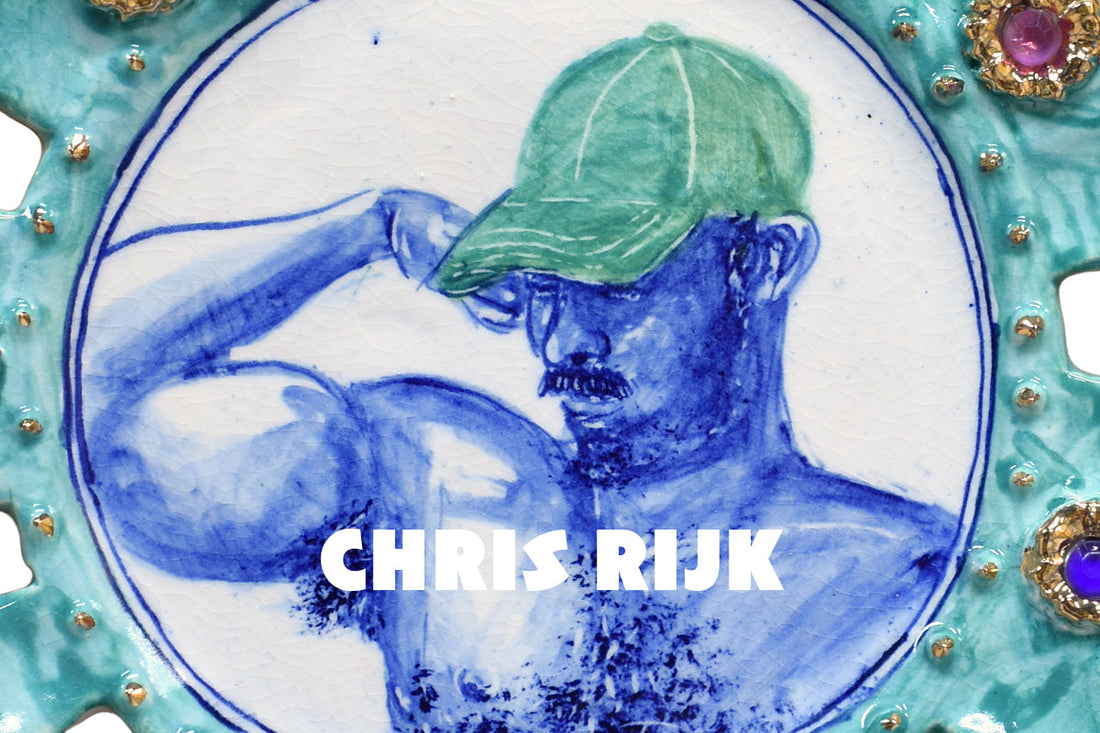
Chris Rijk: Giving Delft Blue a Queer Makeover
Welcome to the wonderfully irreverent universe of Chris Rijk, a Dutch visual artist who takes one of the Netherlands' most recognizable artistic traditions and gives it a thoroughly contemporary twist.
Featured in SNIFF, Scent 3, Chris Rijk brings together the visual language of historic Delftware, homoerotic imagery, contemporary masculinity and a healthy disregard for good taste. His work is funny, provocative, and deceptively thoughtful. Beneath the cheeky surface lies a serious interest in who we are, who we want to be, what society expects us to look like, and why sexuality still becomes a problem when it appears somewhere supposedly respectable.
For a magazine interested in queer art, fetish culture and the pleasures of challenging convention, Chris Rijk feels right at home.

A Dutch Tradition With a New Point of View
To understand what makes Chris Rijk's ceramics so distinctive, it helps to understand the tradition he is playing with.
Delftware, particularly the famous blue-and-white variety known as Delft Blue, emerged as a major Dutch ceramic tradition during the seventeenth century. Its development was closely connected to the growing European appetite for Chinese porcelain, which entered the Netherlands through international trade. Dutch potters sought to reproduce the elegant appearance of these imported objects, developing tin-glazed earthenware with a smooth white surface that provided an ideal background for painted decoration.
The city of Delft became the centre of this production. By the late seventeenth century, its workshops were producing a remarkable range of objects, from domestic plates and bowls to elaborate vases, flower holders and decorative showpieces. Floral patterns, landscapes, architectural scenes and ornamental borders became familiar features of this celebrated craft.
As the Museum Prinsenhof Delft's history of Delftware explains, the blue-and-white style developed from an encounter between imported Chinese porcelain, Dutch technical ingenuity and the tastes of European consumers. The result became a visual tradition in its own right, with a long afterlife in Dutch decorative arts.
That history provides fertile ground for an artist like Chris Rijk.
Rather than abandoning the familiar forms and decorative vocabulary of Delft Blue, Chris Rijk embraces them. His plates, vases and other ceramic objects retain the visual cues that make the tradition immediately recognizable. Intricate borders, decorative flowers, geometric patterns and carefully painted figures all contribute to the illusion that we are looking at something drawn from another century.
But the subjects have changed considerably.
Where historic Delftware might feature a pastoral landscape or an ornamental arrangement of flowers, Chris Rijk introduces contemporary queer life, sexual imagery, masculine fantasies, consumer brands and references to the visual culture we encounter every day. The result is an ongoing conversation between an inherited artistic language and the world in which we actually live.
It is not simply a matter of putting modern pictures on old-fashioned pottery. Chris Rijk understands that the associations surrounding Delft Blue are part of the work itself. Its familiarity, domesticity and reputation for decorative respectability make it the perfect vehicle for imagery that disrupts those expectations.

Queerness Belongs on the Decorative Shelf
One of the most compelling aspects of Chris Rijk's work is his desire to see homoerotic imagery accepted as a decorative motif, rather than automatically treated as something political, fetishized or inappropriate for public view.
That idea runs through his practice. Male bodies, erotic encounters and expressions of queer desire need not be confined to specialist publications, private collections or spaces explicitly designated for adult content. They can occupy the same everyday visual territory as flowers, fruit, landscapes and ornamental patterns.
Consider the glazed earthenware plate pictured here. An octagonal white centre is surrounded by blue geometric patterns and floral medallions, the decorative elements recalling the historic pottery tradition. In the middle, a painted masculine figure extends his hand toward the viewer, with the gesture giving the otherwise traditional object its unmistakable attitude.
There is an intimacy to the hand-painted image, with its loose brushwork and variations in blue. The figure feels personal rather than mechanically reproduced, while the surrounding ornament places him firmly within the visual language of Delftware.
The contrast is immediate, but the deeper point is about belonging. Why should a queer figure, a sexual gesture or an image of male desire look out of place on a traditional ceramic plate? The discomfort says as much about the cultural boundaries surrounding sexuality as it does about the object itself.
Chris Rijk's approach suggests that queerness does not always need to announce itself through a flag, a manifesto or a slogan. It can exist in the details of everyday life, painted into a decorative border and fired into a material that may outlast everyone who encounters it.
That quiet insistence on visibility gives the work its edge.

The Man He Wants to Be
Masculinity is another recurring subject in Chris Rijk's ceramics, and his treatment of it is refreshingly personal.
In his own description of his practice, Rijk has spoken about making work connected to the man he longs to be: big, hairy, muscular, tattooed and deep-voiced. The joke, of course, is that the person he actually is happens to be a potter.
It is a funny line, but there is something recognizable underneath it. Queer culture has never been immune to rigid ideas about what constitutes an attractive or desirable man. Muscular physiques, body hair, tattoos, confidence and a particular kind of rugged masculinity can become their own codes, shaping how men perceive themselves and one another.
For gay men especially, desire can sometimes become tangled with aspiration. We might want a particular body, a particular presence, or a place within a masculine ideal that seems just beyond our reach. The fantasy can be pleasurable, motivating, absurd and occasionally unforgiving.
Chris Rijk turns that tension into material for art.
His ceramics explore the gap between self-image and social expectation without requiring every viewer to arrive at the same conclusion. Humour provides a way into the subject, allowing personal insecurities and exaggerated masculine ideals to coexist without becoming a lecture.
This is one reason his work speaks so naturally to queer audiences. The imagery can be erotic, but it also reflects the cultural codes that make certain bodies desirable and certain expressions of masculinity seem more legitimate than others.
In the world of Chris Rijk, these codes are available for inspection, amusement and reinterpretation. They can be painted onto a plate, transformed into an ornamental object or placed in a context that makes their supposed seriousness difficult to maintain.
There is pleasure in that irreverence, particularly when the subject is something as familiar and loaded as the ideal male body.


Sex, Consumerism and the Objects We Worship
Chris Rijk's interests extend beyond sexuality. His ceramics also examine consumer culture, capitalism, popular imagery and our contemporary obsession with identity.
Brand names, fast food, social media, digital culture and the pursuit of authenticity all find their way into his visual world. A familiar decorative object might become a commentary on commercial excess, while a traditional vessel can carry references to the fleeting trends that dominate contemporary life.
The Frans Hals Museum's presentation of his work highlights this combination of Delftware, queer imagery and pop culture, including references to commercial products and the everyday visual environment.
There is a clever tension here. Consumer culture encourages us to define ourselves through the things we purchase, display, desire and collect. We construct identities through clothing, brands, digital profiles, bodies and lifestyles, all while being told that authenticity is something we should strive to achieve.
Chris Rijk takes these contradictions and gives them a physical form.
A ceramic object cannot scroll past us at the speed of a social media feed. It demands a different relationship with time. We see its surface, examine the detail, notice the brushwork and encounter the image as a tangible thing. The object occupies space, and its decoration remains available for repeated viewing.
This permanence matters to Rijk. Ceramics can survive for centuries, and archaeological discoveries allow future generations to reconstruct aspects of lives that would otherwise have disappeared. He has described his work as a kind of time capsule, an opportunity to leave behind a record of contemporary culture.
Imagine someone discovering one of his plates hundreds or even a thousand years from now. What would they make of our sexual obsessions, commercial icons, masculine ideals and preoccupations with identity? Would the objects seem outrageous, ordinary or entirely incomprehensible?
Perhaps they would understand more than we expect.


Why Ceramic Art Is Such an Effective Disruptor
Part of the brilliance of Chris Rijk's work lies in the medium itself.
Ceramics carries associations with domestic life, family inheritance, craftsmanship and established ideas of good taste. A decorated plate can appear harmless, even quaint. A vase may be treated as little more than a functional object or a decorative accessory.
That perceived innocence creates room for experimentation.
Chris Rijk has observed that people do not necessarily expect ceramics to shock them. The medium's respectable reputation can become an advantage, allowing provocative imagery to enter spaces where it might otherwise be excluded or viewed with immediate suspicion.
The artist does not need to discard the history of Delftware to challenge its conventions. Instead, he works from within that history, using its familiar forms to question the boundaries separating fine art, craft, decoration, sexuality and social commentary.
There is also an interesting relationship between surface and substance. The glaze, ornament and carefully arranged patterns can initially draw us in through their craftsmanship. The subject matter then complicates that first impression, introducing questions that cannot be resolved simply by deciding whether we find an object beautiful.
And beauty is still important here. The work is not interesting merely because it is provocative. Its effectiveness depends on the relationship between the subject and the ceramic form, on the skill involved in decorating the object, and on the way the image acquires new meaning within an established tradition.
The humour works because the craft is real. The disruption works because the object looks as though it belongs.

Chris Rijk in SNIFF, Scent 3
At SNIFF, we are interested in queer creativity that takes desire seriously without taking itself too seriously. Chris Rijk brings precisely that combination to his ceramics. His work is playful, explicit when it needs to be, culturally observant and willing to make a little trouble.
His practice has also attracted institutional attention. Chris Rijk's work has been presented by museums including the Frans Hals Museum and Museum W, bringing his reconsideration of Dutch ceramic heritage into established cultural spaces. He has also exhibited through Rademakers Gallery in Amsterdam and at international art fairs.
That journey from studio practice to museum display is especially fitting for an artist interested in the question of what gets preserved. His work unsettles conventional ideas about decorative pottery while creating objects that are perfectly capable of joining the historical record themselves.
The result is queer art with an unusual relationship to time. It looks directly at contemporary desire, the absurdities of consumer culture and the pressures surrounding masculinity, yet it does so through a tradition that stretches back centuries.
For readers of SNIFF, Chris Rijk offers a reminder that queer expression belongs everywhere, including on the plate, the shelf and the museum wall. Erotic imagery does not lose its artistic value because it is sexually suggestive. Nor does a traditional craft become less significant when it is used to question convention.
Sometimes the most effective way to challenge respectability is to make something beautiful, put it on display and refuse to apologize for what it shows.
Discover Chris Rijk in SNIFF, Scent 3, alongside an international collection of queer artists exploring sexuality, fetish culture, identity and creative expression.
Follow Chris Rijk
Website: chrisrijk.nl
Instagram: @chrisrijk
Gallery representation: Rademakers Gallery


