
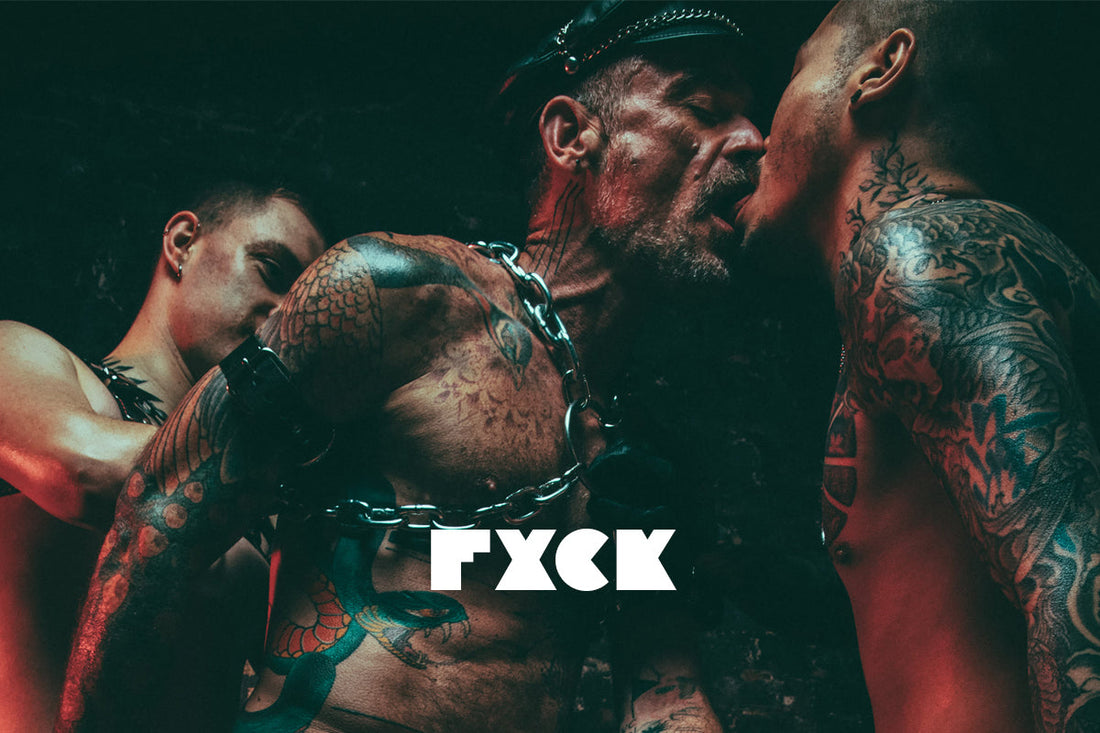
FXCK: Rewriting the Rules of Queer Fetish Community
A room full of leather, attitude, skin, and cameras can make a hell of an image. But what happens when that image carries a bigger idea, one that asks who gets to occupy the same space, whose experiences are represented, and how a community can move beyond the boundaries it has inherited? That is the thinking behind FXCK, an ambitious queer fetish initiative bringing London's leatherdykes and leathermen into the same frame, with a clear message about visibility, inclusion, and the future of kink culture.
Featured in SNIFF, Scent 3, FXCK puts community at the centre of the picture. Conceived by KrugerAfterDark and photographed by Colin Davis, the project grew from conversations already happening within London's fetish scene. Its ambition is to turn those conversations into something tangible, visually arresting, and difficult to ignore.

From KrugerAfterDark to FXCK
To understand FXCK, it helps to understand the person who imagined it. KrugerAfterDark is a fetish community journal with an active presence on Instagram, documenting and discussing the culture from within rather than treating it as an outsider's curiosity. The project also extends into publishing, with the AfterDark Zine bringing together art, photography, and written work. On Bluesky, KrugerAfterDark identifies as the concept originator of FXCK, connecting the initiative to a wider interest in creative expression and the communities surrounding fetish.
That interest includes challenging the way kink is perceived beyond its own circles. In a Guardian feature discussing the film Pillion and its depiction of BDSM, KrugerAfterDark reflected on how fetish culture has often been portrayed through stereotypes, with practitioners reduced to threatening, pathological, or comic figures. The discussion highlighted the importance of seeing the human relationships and emotional realities that exist within kink.
It is a useful starting point for understanding FXCK. Representation is not simply about putting people in front of a camera. It is about how they are seen, which stories become visible, and whether the image being presented reflects the diversity of the people who make up the community.
FXCK takes that question into a distinctly London setting, where established leather traditions, newer forms of queer expression, and different communities with their own histories have an opportunity to meet on more connected terms.


The conversation that started it
The roots of FXCK can be traced to Leatherbound, the landmark community showcase associated with Mr Leather London 2025. The event was presented as London's first fully inclusive gathering of its kind to bring trans and cis leatherdykes and leathermen together, celebrating performance, creative arts, and exceptional craftwork produced by artists within the kink community.
Leatherbound created an opening for a conversation that needed to continue. What might greater inclusion look like beyond a single showcase? Could communities that had largely developed along separate social paths find more opportunities to connect, collaborate, and share space?
KrugerAfterDark took those questions to the online fetish community, hosting a debate and poll about the future of mixed social events for leatherdykes and leathermen, including trans and cis participants.
The responses offered a clear signal of interest. According to the figures reported in the magazine's FXCK feature, 83% of respondents expressed strong support for greater inclusivity across the fetish community, particularly through mixed events bringing together trans and cis dykes and men. A further 65% advocated for mixed play spaces as part of those gatherings.
Those figures matter because they point towards a conversation about how community spaces are made and who feels welcome in them. Socialising, sharing a dance floor, watching a performance, talking gear, exchanging ideas, or participating in play are all ways people build connections. When opportunities to meet are limited, those connections can remain limited too.
The poll was not the end goal. It became a starting point for something more visible.


Enter FXCK
Determined to carry the momentum forward, KrugerAfterDark conceived FXCK as a high-aesthetic, inclusive photoshoot designed to encourage more mixing, socialisation, and unity between groups that had historically developed in their own circles.
The visual approach is important. Fetish photography has a long relationship with identity, performance, style, and the construction of desire. Leather, rubber, hardware, uniforms, and other elements of kink can be deeply personal, carrying associations with belonging, power, trust, and self-expression. Photographing these elements within a shared creative project gives them another layer of meaning.
Here, the people in the images are not simply models wearing fetish gear. They are participants in a wider community conversation, bringing their own identities, histories, and relationships to the frame.
Model selection was approached with that diversity in mind, spanning a range of ages and ethnic backgrounds. Trans participants were included, among them the President of London Leatherdykes. Established figures from the dyke community joined established leathermen from London's scene, including Mr Leather London 2025 and KrugerAfterDark themselves.
That combination gives the project a grounding in the scene it hopes to bring closer together. It places recognisable community figures alongside participants whose presence helps make the wider point about inclusion. The result is intended to represent a broader cross-section of London's kinky population, not a single uniform idea of what a fetish community should look like.
There is something powerful about making that effort visible. A photograph can capture the surface details of a scene, from the cut of a leather jacket to the shine of a buckle or the confidence of a pose. It can also suggest who belongs in the picture, who stands beside whom, and what kinds of connections might be possible beyond the shoot itself.
FXCK uses that visual language to make a case for greater openness.


Colin Davis: Fetish through an artistic lens
The photographs accompanying the FXCK feature were taken by Colin Davis, a London-based photographer whose practice explores masculine beauty through a distinctive meeting of classical art influences and the raw intimacy associated with pornography.
Davis describes his photography as dark, fantastical, and painterly, with a deliberate interest in pushing the boundaries of what audiences recognise as fine art. His work challenges the restrictions placed on sexual imagery in a media landscape where anything considered unsuitable for conventional advertising can easily be pushed out of view. His photography has been exhibited in Antwerp, Chicago, and London, and his 2024 exhibition Filth, created with oil painter Orpheus, marked his first major show. Alongside his photographic practice, Davis has built a career in creative technology, film, visual effects, and innovation.
That combination of visual ambition and a willingness to engage with uncomfortable subject matter makes his contribution particularly relevant to FXCK. The project needs imagery with presence, but it also needs a photographer capable of treating fetish as a subject worthy of considered artistic attention.
Davis's work offers room for both. Masculine form, styling, atmosphere, and sexuality can coexist within an image without stripping the people in it of their individuality. His approach helps place the FXCK participants inside an editorial visual world while retaining the unapologetic energy of queer fetish culture.
The photographs are a central part of the initiative's message. They give the conversation a visual identity, helping the people and communities involved be seen together, on their own terms.
Why visibility matters
Inclusivity can become an easy word to use, particularly when it appears in the language of events, publications, and organisations. Its meaning becomes more substantial when it affects who is invited, who is represented, how people interact, and whether different groups can build relationships that continue beyond a particular occasion.
FXCK's focus on bringing leatherdykes and leathermen together speaks directly to that challenge. Shared interests in leather and kink provide a starting point, but community is built through actual contact, shared experiences, and the willingness to make room for people whose identities and social histories may differ.
Mixed events can create opportunities for those encounters. Mixed play spaces, when thoughtfully organised and grounded in clear boundaries and consent, raise additional questions about how welcoming environments are designed to support participants with different needs and expectations.
A photoshoot cannot resolve every issue involved in bringing communities together, and it does not need to claim that it can. Its value lies in making the intention visible, giving a platform to people who are already part of the scene, and helping sustain a conversation about what comes next.
That is also why the project's connection to community-driven creative work matters. The people involved are not just a subject for an editorial spread. They are part of the culture being represented, and their participation gives the work a connection to the lived reality of the scene.
For queer fetish culture, that distinction matters. Images of leather, harnesses, latex, and other fetish aesthetics circulate widely, but an image of the gear is not necessarily an image of the community. FXCK wants to bring the people, relationships, and shared spaces back into focus.

FXCK in SNIFF, Scent 3
At SNIFF, we are interested in queer art and fetish culture as they exist in the real world, with all their creativity, contradictions, obsessions, and community connections. Our third issue, Scent 3, expands that interest beyond presenting artwork to documenting community-based initiatives and events.
FXCK is an important part of that shift. Alongside the photography, illustration, painting, and erotic writing in the magazine, the feature brings readers closer to the people shaping queer fetish culture themselves. It examines the work of building connections, creating visibility, and challenging the divisions that can persist even among people who share a passion for kink.
The initiative also raises a question worth carrying beyond the pages of the magazine: what could happen if more of our community spaces were built around the possibility of meeting, rather than the assumption that everyone should remain within familiar circles?
FXCK does not pretend that one project can answer everything. Instead, it puts the question into the room, into the photograph, and into the wider conversation about queer fetish life in London.
That is a compelling reason to pay attention.
FXCK brings a strong visual identity to an idea with real community significance. KrugerAfterDark supplies the vision and the impetus, Colin Davis brings an assured photographic eye, and the participants make the project meaningful through their presence. Together, they offer a portrait of a fetish community exploring how it might become more connected, more representative, and more open to the people who want to be part of it.
Discover the FXCK feature in SNIFF, Scent 3, the latest edition of our queer fetish arts magazine, featuring artists and writers who are pushing the culture in their own directions. For those interested in the conversations happening behind the imagery, FXCK is well worth a closer look.
Explore FXCK Online
FXCK Initiative on Instagram: https://www.instagram.com/the_fxck_initiative/
KrugerAfterDark on Bluesky: https://bsky.app/profile/krugerafterdark.bsky.social
KrugerAfterDark and the AfterDark Zine: https://linktr.ee/krugerafterdark
Colin Davis, photography: https://www.colin-davis.com
Enjoy Our Other Magazines


