
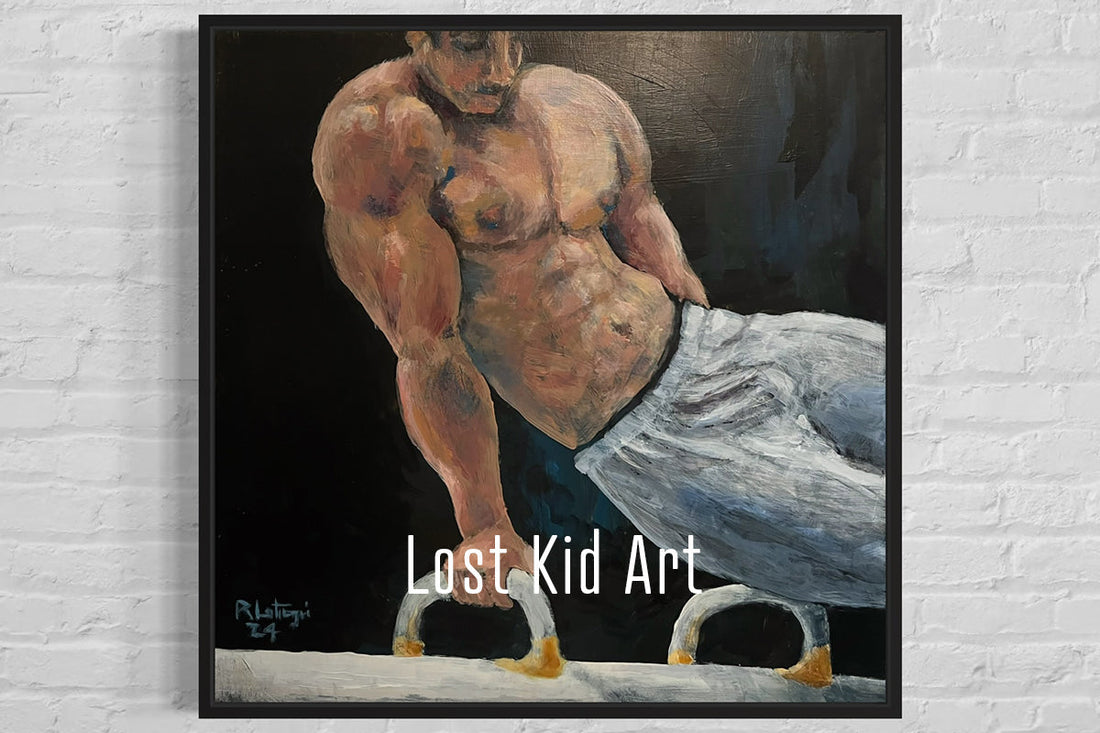
Paint, Sweat, and Something Deeper: Lost Kid Art in Inspiró Issue 2
Pick up a copy of Inspiró magazine Issue 2 and you will feel something shift the moment you land on a page by Lost Kid Art. Not just appreciation, not just admiration, but something closer to desire, the particular charge that comes when a painting seduces you at first glance. The Madrid-based artist, who goes by Lost Kid Art, brings a ferocity to figurative painting that is rare in any context and genuinely electrifying within the landscape of contemporary queer art. His work is one of twelve featured contributions in Inspiró Issue 2 (Winter 2025), the acclaimed queer art publication from The Male Muse, and it earns every inch of that placement.

Take Adversario I, the canvas shown here. A wrestler stands alone against a storm of deep blue, his body rendered in ochre and gold and shadow, muscles coiled beneath the surface of the paint. He is not posing. He is not performing. He is simply present, gaze dropped, arms loose at his sides, the weight of competition and perhaps something heavier resting across those broad shoulders. The brushwork is urgent in places and deliberate in others, the kind of mark-making that tells you the artist knows exactly when to push and when to hold back. Color bleeds at the edges of muscle and bone. The background is not a backdrop but a mood, a bruised, churning atmosphere that presses in around the figure as if the arena itself has feelings.
This is what Lost Kid Art does: he takes the body, specifically the male body in extremis, the athlete straining, the gymnast suspended, the wrestler pinned or rising, and he transforms it into a vehicle for emotion that language cannot carry.

From Game Dev to Gallery Walls
The backstory makes the work richer still. A native Madrileño, Lost Kid Art spent twenty years as an art director in the video game industry, a career that fused his dual passions for computer science and visual craft. He knows composition instinctively. He understands light and shadow as tools of narrative. And then in 2022, something shifted: he picked up a brush not as a professional exercise but as a cathartic one, as a way of processing physical and emotional pain that had accumulated in ways words could not address.
That origin matters. It explains why his paintings carry such charged emotional weight even when the subjects are outwardly athletic, outwardly strong. The wrestler in a gold singlet is not simply a study in musculature. He is a stand-in for internal states, for struggle and endurance and the particular ache of competing against forces that cannot be seen. Lost Kid uses abstraction and color not to decorate a figure but to excavate it, to reach what he describes as the deep emotions, experiences and internal states that are impossible to describe with words.

Color, Body, Abstraction
Three elements run through all of Lost Kid's work: color, abstraction, and the male anatomy. In practice these are inseparable. His color choices are not naturalistic, they are emotional. The golds and ochres of a wrestler's uniform push toward the warmth of skin under arena lights, then tip into something almost sacred, an icon from an old painting seen through a contemporary queer lens. His shadows are not grey but violet and deep brown, alive with feeling. The backgrounds shift between teal and near-black, between turbulence and void.
He also maintains a restlessness toward material and technique, constantly searching for new methods that allow him to push beyond conventional visual limits. The result is work that feels alive even in reproduction, that suggests the hand and the urgency behind it, and that remains deliberately open, resisting a single interpretation in favor of a personal connection with whoever stands before it.
That openness, that refusal to close things down, is one of the reasons his paintings find such resonance. A viewer brings their own experience of physical discipline, of competition, of masculine expectation or the ways it has been imposed upon them, and the paintings hold space for all of it.

Already Collected Across Five Continents
In only a few years of painting, Lost Kid Art has built a following that extends well beyond Madrid. His work now sits in private collections across Madrid, Amsterdam, Milan, Los Angeles, Krakow, Lima, and Washington, a geography that speaks to the borderless appeal of art that deals honestly with the body and with feeling. He has no website as of yet, but his Instagram (@lost_kid_art) offers an ongoing window into a practice that is evolving rapidly and visibly. You can follow him there to keep up with his latest works and exhibitions around the globe.
Lost Kid Art's appearance in Inspiró Issue 2 places him alongside eleven other international artists spanning photography, digital media, collage, and sculpture, all united by the magazine's mission to elevate queer art into a collectible, premium print format.

Find Out More About Lost Kid Art and Why This Work Matters
Queer art has always had a complicated relationship with the male body, oscillating between desire and critique, between celebration and interrogation. Lost Kid Art does not choose sides in that tension; he inhabits it. His wrestlers and gymnasts and athletes are desirable and vulnerable, powerful and exposed, triumphant and exhausted, often all at once. They are painted with a queer gaze that refuses to reduce them to spectacle, insisting instead on interiority, on the emotional life beneath the skin.
For a painter who came to fine art through pain and through the body's own insistence on being heard, that feels exactly right. The canvas becomes the arena. The figure becomes the fight. And the viewer, wherever they stand, gets to decide what it means to them.
Lost Kid Art is featured in Inspiró Issue 2 (Winter 2025), published by The Male Muse. Order your copy at themalemuse.store.
Please note the US customers will need to order from The Male Muse Blurb Store due to current publishing restrictions. We are very sorry for this inconvenience, but it is entirely out of our control.
Follow the artist on Instagram @lost_kid_art.


