
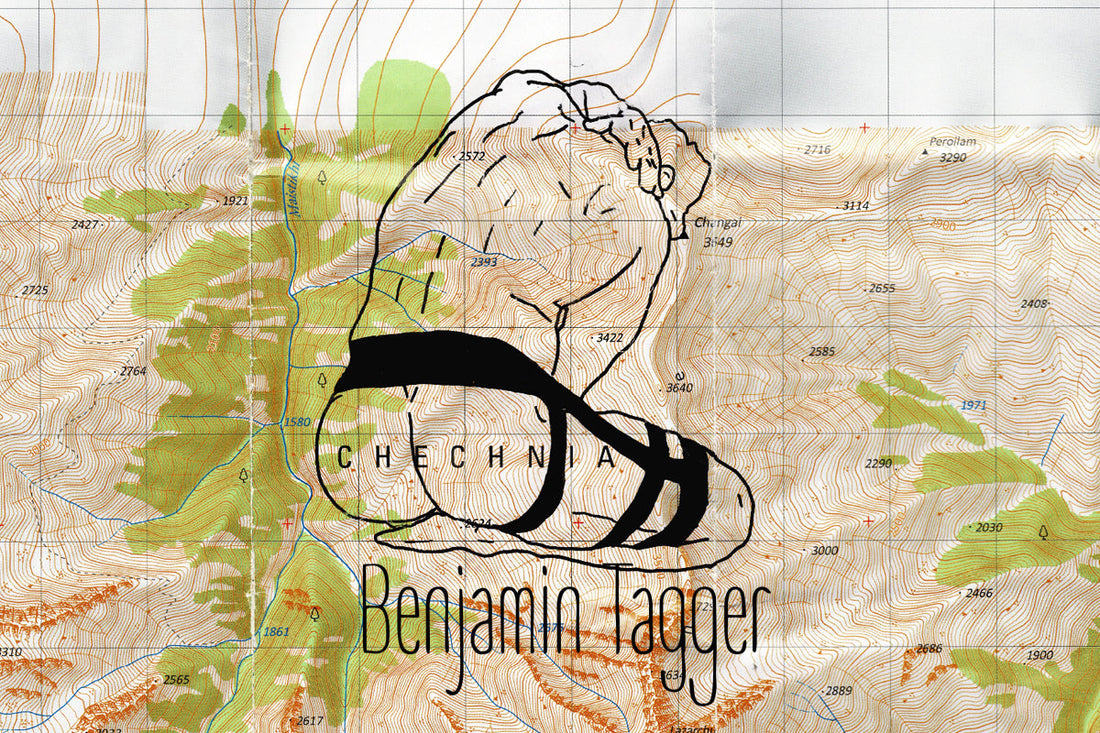
There is a particular kind of silence that holds desire before it learns to speak. For Benjamin Tagger Salazar, that silence has become a medium. Working across photography, collage, drawing, and mixed media, the Venezuelan-born, Montreal-based artist has built a practice out of bodies, maps, and the charged space between strangers, a space where intimacy is claimed without explanation, and queerness exists not as statement, but as quiet, undeniable fact.
We are proud to feature Benjamin Tagger in Inspiró Magazine Issue 7, where his work joins a constellation of twelve artists whose practices are expanding what queer art looks like, feels like, and dares to say.

An Architect of Intimacy
Before Tagger was a visual artist, he was training as an architect. He earned his Bachelor of Architecture at the Bezalel Academy of Art and Design in Jerusalem in 2018, one of the most rigorous design schools in the world, and it was there that his obsession with maps first took root.
Maps, as he describes it, offered him something a blank canvas could not: an existing world of lines, colors, and spatial data to push against and play within. They carried personal weight too, the cartographic contours of Venezuela where he was born in 1991, places he had traveled, places that existed only in imagination. That architectural sensibility, the understanding of space as something experienced, navigated, and emotionally charged, runs through everything he makes.
Since relocating to Montreal, Tagger has continued to exhibit internationally. His work has been shown in galleries across Tel Aviv, and his visual language has only grown more layered and precise with time.

You Are on My Map
At the center of Tagger's practice is his ongoing photographic series, You Are on My Map, a project that is as much about encounter as it is about image-making.
The premise is deceptively simple: Tagger photographs mostly unfamiliar men. But the process itself is where the work lives. Working with strangers introduces something irreducible, uncertainty, trust, the negotiation of vulnerability between two people who don't fully know each other yet. That charged atmosphere doesn't disappear from the final image; it becomes the image.
In his own words, he describes the creation process as moving "through different levels of intimacy, within myself, between the model and himself, and between the two of us." What begins as a private act in the studio, nudity behind closed doors, a kind of taboo, transforms into something open, offered to the world. The exposure that society teaches us to hide becomes, in Tagger's hands, the very source of meaning.
The photographs then meet maps. Bodies are layered against geographic forms, terrain lines, city grids, coastal shapes, creating compositions where flesh and cartography become inseparable. The body becomes a place. The map becomes a body. Proximity, distance, control, and desire are all encoded in the same image.

Eroticism as a First Language
What makes Tagger's work so distinctive, and so quietly radical, is how he frames eroticism. Not as provocation. Not as shock. But as language.
In his biography for this issue, he writes: "Eroticism is a language learned in silence. It is a way to express desires that once had no place to be spoken."
This is the emotional core of his practice. His images function, he says, as intimate self-portraits, not because he is always in them, but because every photograph carries the imprint of his own looking, his own longing, his own process of learning to inhabit a queer identity without apology. Queerness in his work is not explained or justified. It is simply present, claimed through looking, through touch, through the act of mapping another body.
His second ongoing series, Becoming Friends, explores a related but distinct territory: the warmth, humor, and tenderness that can exist between queer men outside the frameworks of romance or sexuality. Together, the two bodies of work trace the full spectrum of connection, from the electric charge of desire to the quieter, equally complex register of friendship and care.

Why Benjamin Tagger Belongs in Issue 7
Inspiró Magazine has always been committed to showcasing artists who don't just make work about queer life, they make work from inside it, with all the complexity, beauty, and contradiction that entails. Benjamin Tagger does exactly this.
His practice asks us to sit with discomfort and tenderness simultaneously. It refuses the easy read. And it insists, with great care and precision, that queer desire is not a footnote to art history, it is a cartographic tradition of its own, mapping territories that have always existed but were too long left unnamed.
Inspiró Magazine Issue 7 is available now, featuring twelve artists whose work is as varied as it is vital. Benjamin Tagger is one of them, and once you see how he maps a body against the world, you won't forget it.
Get your copy of Inspiró Issue 7 and follow Benjamin Tagger's ongoing work at benjamintagger.com.


