
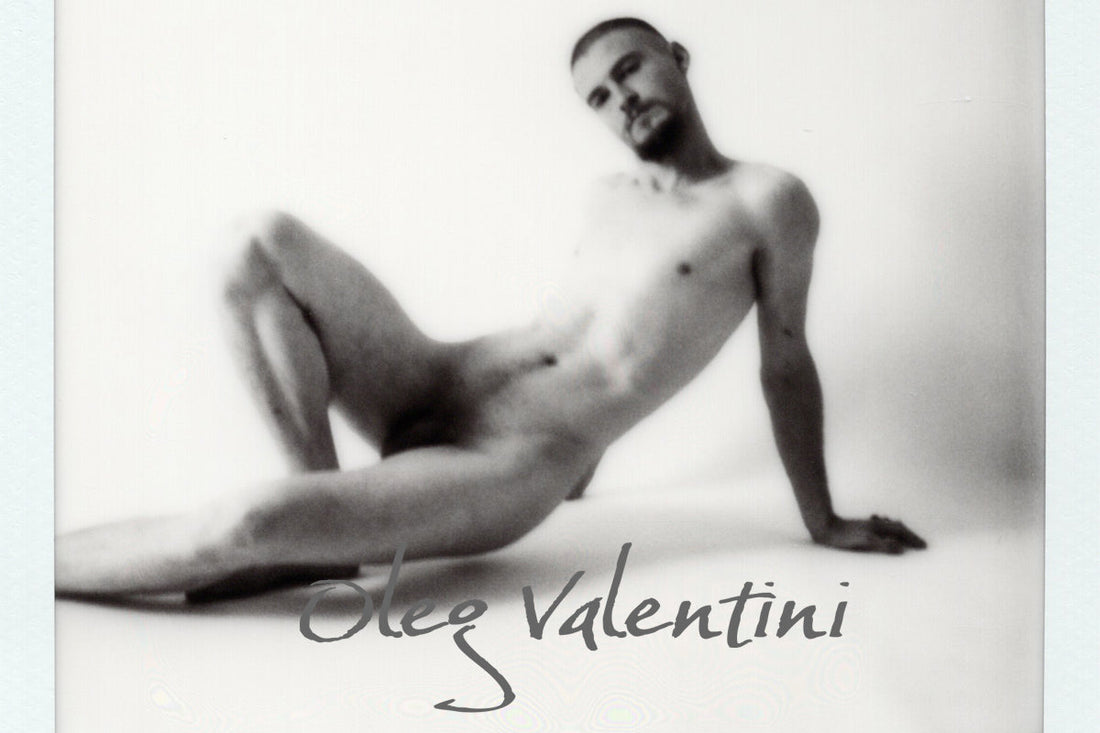
There's something quietly radical about choosing a Polaroid camera in an age of infinite digital images. For Oleg Velentini, that choice isn't nostalgia, it's philosophy. It's a commitment to the singular, the irreversible, the real. And it's the medium through which this Kiev-born, Italy- raised queer photographer has spent the past year building one of the most intimate archives of male beauty you're likely to encounter.
Velentini is one of twelve artists featured in Inspiró Magazine Issue 7, the quarterly publication by Mark Alan (creator of The Male Muse) that celebrates gay erotic art across photography, painting, illustration, digital art, collage, ceramics, and more. Each issue brings together 100+ pages of international voices, and this seventh edition is no exception.

A Life Shaped by Art, Across Borders
Oleg's story begins in Kiev, Ukraine, where he was born before being adopted and raised in Italy. That dual heritage, Slavic roots, Italian upbringing, quietly informs the way he sees the world: as someone who has always inhabited more than one kind of beauty, more than one kind of home.
From an early age, art was less a hobby and more a necessity. He explored drawing, theatre acting, and singing before eventually graduating from the prestigious art school in Forlì, in the Emilia-Romagna region of northern Italy. That foundation in classical training, the discipline of form, the study of the human figure, courses through everything he does now behind a camera.
The Camera as Freedom
It wasn't until 2024 that Velentini turned his lens specifically toward the male form. What began as an aesthetic exploration quickly became something more personal.
"Photography allows me to express what I like, share it with others, and helps me to feel free," he says.
That word 'free' carries real weight for a queer artist working in a country with a complicated relationship to LGBTQ+ visibility. Photography, for Velentini, isn't simply documentation. It's declaration.
His range of subjects reflects the breadth of his aesthetic sensibility: from the classical beauty of form, the kind studied in art schools, drawn in charcoal, sculpted in marble, to a rawer, more rugged masculinity. It's a vision that refuses to flatten male beauty into a single type, and in doing so, opens up a more expansive and honest conversation about what it means to look, to desire, and to create.


Why Polaroid?
The photos featured in Inspiró 7 represent a year-long collection, captured across multiple Polaroid formats. That choice of medium is significant.
Polaroid photography occupies a unique and storied place in the history of queer art. Robert Mapplethorpe, arguably the most iconic name in the photography of male beauty and queer desire, began his legendary career with a Polaroid camera in the late 1960s. The format's immediacy, its imperfection, its intimacy, made it the natural companion for artists working outside mainstream visibility, creating images that were private before they were public.
There's something about the Polaroid that immediately offers comfort and privacy, the image exists in physical space the moment it's made, not held somewhere in the cloud to be edited, filtered, and reconsidered. What you see is what happened. For a photographer exploring beauty and desire, that honesty matters.
For Velentini, the year-long Polaroid series is also an act of sustained attention, resisting the throwaway speed of digital photography in favour of intentional, considered images. Each frame costs something. Each one is kept.


Classical Training Meets Queer Vision
What distinguishes Velentini's work from casual portraiture is precisely that art school foundation. He brings to his photography the same eye trained on Renaissance figure studies and life drawing: an understanding of light and shadow, the geometry of the body, the way a pose can carry both tension and grace.
But where the classical tradition so often erased or sublimated queerness, Velentini brings it front and centre, not as provocation, but as naturalness. The male body he photographs is desired openly, framed with care, and presented without apology. That combination of rigorous aesthetic training and queer subjectivity is where his work becomes most interesting.
Part of Something Larger
Being featured in Inspiró 7 places Velentini within a vital community of international queer and homoerotic artists who are building something genuinely rare: a printed, archival home for this kind of work. In a media landscape where so much queer visual art lives and dies on social platforms, subject to algorithmic censorship and fleeting attention, Inspiró offers permanence. Physical pages. A collectible object.
Each issue of Inspiró showcases 12 artists working across wildly different modalities, and the result is always a conversation rather than a monologue, artists in dialogue with each other and with the long history of queer aesthetics. Velentini's Polaroids, with their analog warmth and classical eye, bring a particular texture to that conversation.

Get Inspiró 7
Inspiró Magazine Issue 7 is out now. With twelve artists and over 100 pages of original work celebrating gay erotic art in all its forms, it's the kind of publication that demands to be held, not scrolled.
Follow Oleg on Instagram @olegvalentini.ph


