
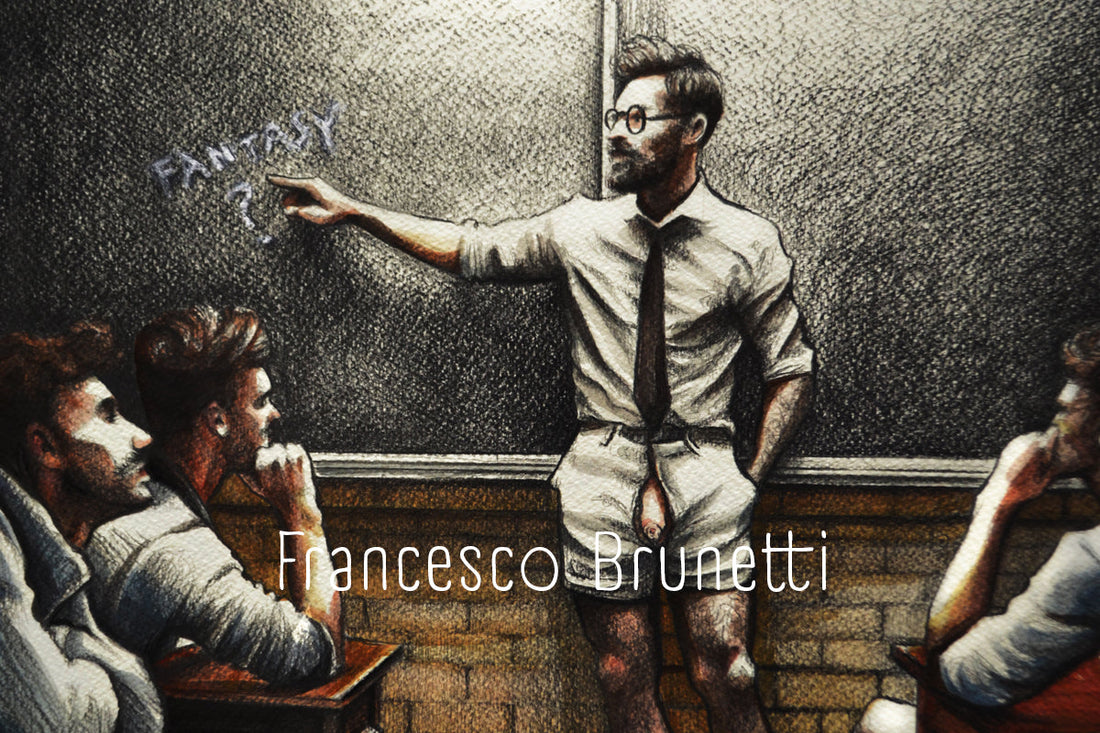
Francesco Brunetti: Intimate Pencil Illustrations Bring Male Nudity To Everyday Scenarios
When nudity appears in unexpected places, our instinctive response reveals more about us than about the image itself. This is the quiet power of Francesco Brunetti's practice, where the most intimate of human forms emerges not in the gallery or the bedroom, but in the office, the street corner, the threshold between public and private. His pencil illustrations invite us into scenarios that feel almost mundane until we recognize the deliberate disruption at their center, forcing a reckoning with our own discomfort, desire, and the assumptions we carry about bodies, masculinity, and visibility. We're honored to have his work gracing the second anniversary edition of Inspiró magazine.

Brunetti's approach to figurative art operates from a distinctly queer perspective, one that refuses to compartmentalize vulnerability as something separate from power or strength. Italian-born and London-based, Francesco Brunetti has spent years developing a visual language that positions the male body not as object of conquest or worship, but as a site of genuine complexity. His work asks: what happens when we see men as they are, undefended and unadorned, in the spaces where we expect them to be armored?
The journey to this clarity began in Naples, where Brunetti studied at the Academy of Fine Arts. His early training in traditional figure drawing gave him the technical foundation necessary to render human anatomy with precision and sensitivity, but it was his subsequent studies at the Sotheby's Institute of Art, where he combined artistic practice with business acumen, that shaped his conceptual approach. This dual education appears throughout his work, in the careful composition and intentional staging of his pieces. Francesco Brunetti is not interested in spontaneity for its own sake. Every element, from the fabric of a shirt to the angle of a glance, has been considered.

A Wide Variety of Inspiration
What distinguishes Francesco Brunetti from many of his contemporaries is his willingness to embrace artifice as a tool for authenticity. His creative process begins not with observation of the world, but with the construction of fictional and often outlandish characters and scenarios. He develops these through digitally crafted visual sources before translating them onto paper or canvas, creating a deliberate distance between reality and representation. This methodology allows him to escape the trap of documentary realism, where the goal might be simply to record what is. Instead, Brunetti uses invention as a means to get at something truer, something less about surface appearance and more about psychological and emotional resonance.
His visual references run wide and deep, drawn from figures and artists who have consistently pushed against convention. Madonna's provocative use of the body as a vehicle for power; David LaChapelle's maximalist queerness rendered in technicolor; Guido Crepax's sophisticated erotica; Milo Manara's sensual draftsmanship. These influences coexist in Brunetti's work alongside an engagement with contemporary pop culture more broadly. What might seem like eclecticism actually represents a coherent vision, one that sees high art, popular culture, and sexual politics as inseparable. Francesco Brunetti refuses the hierarchy that would place classical figure drawing above commercial illustration or fashion imagery, recognizing instead that meaning-making happens in the conversation between these registers.

Nudity As Subtle and Playful Social Trangression
The tension between vulnerability and power that Brunetti investigates is not abstract or theoretical. It emerges most powerfully in moments of intimate exposure. In his pencil illustrations, we see men at the edges of ordinary life, their nudity creating a rupture in the everyday. A man stands in a domestic interior, unclothed, while the clothed world continues around him. The composition is neither erotic in the traditional sense nor clinical. Instead, there is something quietly devastating about the exposure, the visibility, the way Brunetti renders the skin with such care that we cannot look away or dismiss the figure as merely decorative.
This is where Francesco Brunetti's queerness becomes essential to understanding his practice. A heteronormative or cisgender-centered approach to the male nude would likely render it either aspirational (the idealized body) or transgressive (the exposed, vulnerable body as violation). Brunetti's vision sidesteps both traps. His men are neither gods nor victims. They are people, specific and particular, contending with the simple fact of their own embodiment in a world that has trained them to hide it. The power of this work lies in its refusal to resolve the tension it creates. We are left uncomfortable, which is precisely the point.
Technical Skills Meet Deep Sensuality
The technical skill required to execute this vision cannot be overstated. Brunetti's pencil work displays a mastery of tonal range and anatomical knowledge that allows him to render skin with luminosity and specificity. There is a sensuality to his draftsmanship that goes beyond mere technical precision, a kind of tenderness in how he renders the human form. The pencil illustrations feel intimate, as though Brunetti is inviting us into a private space, a space of observation and care. The surrounding elements, whether architectural or figural, are rendered with equal attention, creating compositions that feel fully realized and deliberately staged.
Since basing himself in London, Francesco Brunetti has continued to develop this practice, showing his work in gallery and institutional contexts while maintaining a strong presence on social media, particularly Instagram, where his work circulates within queer and artistic communities that recognize the significance of his intervention. The second anniversary edition of Inspiró magazine's decision to feature him reflects a broader recognition that contemporary art practice, and queer art practice in particular, is doing some of the most important cultural work available to us right now.

What's Next
Francesco Brunetti's investigations into vulnerability and power within the male body arrive at a moment when conversations about masculinity, embodiment, and queerness are reshaping how we see and represent ourselves. His pencil illustrations do not provide answers or easy catharsis. Instead, they create spaces where discomfort becomes productive, where looking becomes a form of ethics. In this, Francesco Brunetti has created a body of work that matters, not because it is beautiful or technically accomplished, though it is both, but because it insists that we examine our own gaze and ask what we are really seeing when we look at another body, another person, another life laid bare.
Follow him on Instagram @francesco.brunetti95


