
Scott Mabe Turns Truck Stops and Texas Farmland Into Queer Liminal Space
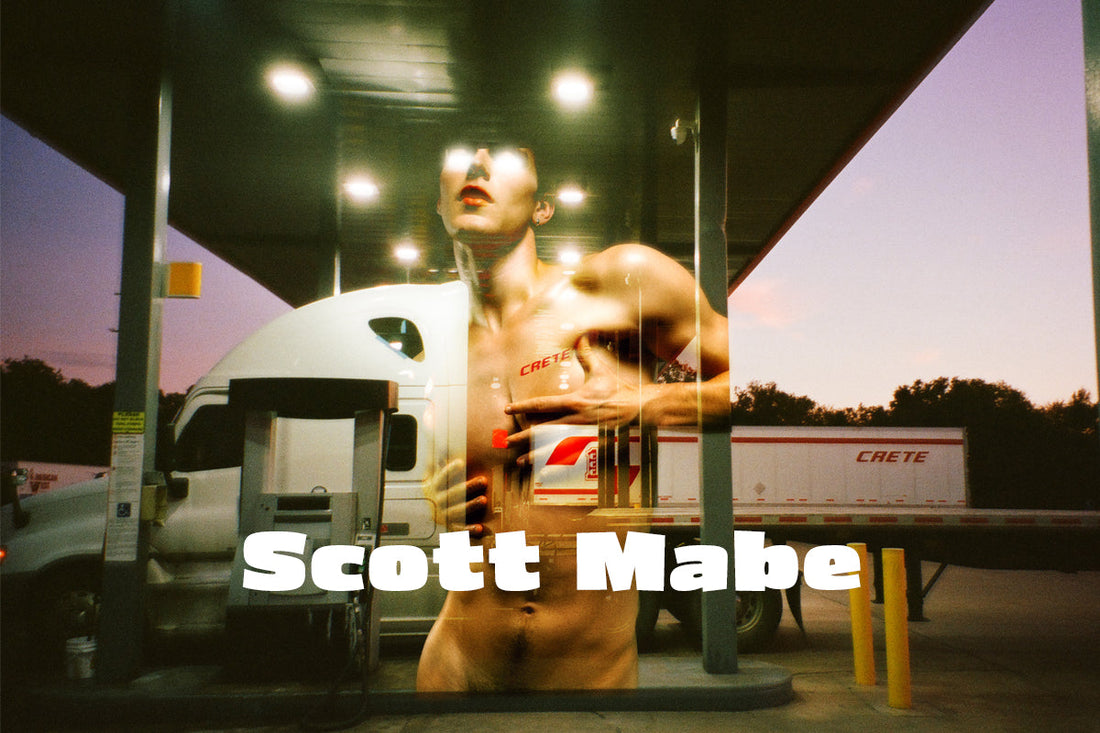
Under the fluorescent wash of a truck stop canopy, a tractor trailer marked CRETE sits parked against a sky the color of a fading bruise, violet bleeding into the last orange light of evening. Superimposed over the scene is the ghost of a man's torso, translucent, lips parted, head tilted back as though caught mid breath. This double exposed collision of rural infrastructure and queer desire is the signature of Scott Mabe, the photographer and digital artist whose work appears in Inspiró Issue 8, the Second Anniversary Edition of The Male Muse's flagship queer art magazine, out now from The Male Muse Store.
Scott Mabe grew up on a dairy farm in East Texas, the youngest of six children raised by a Baptist preacher and a schoolteacher. It was there, on land defined by scripture and routine labor, that he first picked up a disposable Kodak camera and began photographing the landscape around him, along with the people who worked it. Those early images, unpolished and instinctive, planted the seed of a practice that would eventually turn the rural South into raw material for something far stranger and more intimate.

Original model image source: Bob Mizer
After studying photography and art history at the University of North Texas, Scott Mabe relocated to New York City, where he sharpened his skills in digital photo manipulation. The move from rural Texas to a dense, anonymous metropolis gave him both distance and craft, distance from the landscape he grew up in and the technical fluency to reshape it. That combination now defines his current body of work, which layers analog photographs of the rural terrain of his childhood with found digital erotic images, producing compositions that feel simultaneously nostalgic and transgressive. More of that ongoing practice lives on his website, yournakedcousin.com, and on Instagram at @heavymetal_kng, where the same tension between the pastoral and the erotic runs across his broader portfolio.
The image submitted for Inspiró Issue 8 demonstrates this method with clarity. A gas pump, a semi truck cab, yellow bollards, and a strip of dusk colored sky sit in one exposure, while a nude male figure, lit like a specter, occupies the same frame in another. Neither image fully yields to the other. The body and the landscape share space without resolving into a single legible scene, and that unresolved quality is the point. Scott Mabe has spoken about working in the liminal, the in between, and here that liminality is literal, a threshold between the sacred stillness of a rural upbringing and the erotic charge of a body that refuses to stay hidden.

Original model image source: Christian Oita
A Clash of Influences
That interest in threshold spaces runs through everything Scott Mabe makes. Queer identity, in his photographs, does not announce itself in triumphant or celebratory terms. It surfaces instead in the gaps between exposures, in the flicker of a body appearing where a landscape should be, in the tension between what a place was built to represent and what actually happens inside it. Gas stations, motel rooms, and empty highways become sites of desire precisely because they were never meant to hold it. There is a horror movie logic to this, and Scott Mabe has cited horror and weird fiction as ongoing influences, along with heavy metal, both genres built on the idea that something unsettling can live just beneath an ordinary surface. His photographs carry that same tension, beautiful and faintly menacing at once.
Part of what gives Scott Mabe's images their particular charge is the tension between two very different working methods. The rural photographs are shot on film, subject to the accidents of light leaks, grain, and imperfect exposure that analog cameras have always produced. The erotic material is sourced digitally and layered in afterward with deliberate control, adjusted for opacity, color, and placement until the two elements sit in uneasy balance. Chance and control, in other words, are pressed together in the same frame. That balance is what keeps the work from reading as a simple mash up. The viewer senses the hand behind the digital layering even as the film grain insists on its own accidental history, and it is in that friction that Scott Mabe's queer sensibility becomes visible, a body inserted into a landscape that was never built with it in mind, made to belong there anyway.

The Artists of Inspiró Eight
Inspiró Issue 8 marks two years of The Male Muse's flagship publication, and the anniversary framing gives Scott Mabe's inclusion added weight. The issue gathers twelve international artists working across photography, painting, sculpture, and digital collage, among them Lukasz Leja, Björn Koll, Francesco Brunetti, Domingo Elchino, Shax Carter, Fabrizio Tiribilli, Ismael DeLarge, Adan, Jude Ribisi, Kaden Bard Dawson, and Mark Alan, the magazine's founder. Across more than one hundred pages, the issue continues Inspiró's mission of documenting how queer artists around the world explore masculinity, intimacy, and desire through wildly different visual languages. Scott Mabe's contribution stands out for the way it grounds that exploration in a very specific American vernacular, the truck stop, the dairy farm, the flat highway light of East Texas, rather than a more familiar urban or studio setting.
Two Techniques, One Goal
What makes Scott Mabe's work resonate beyond its technical novelty is the honesty underneath the layering. He is not simply juxtaposing sex and landscape for shock value. He is working through the specific contradiction of growing up queer in a household built on scripture and routine, and finding, years later in New York City, the tools to hold both halves of that experience in a single frame. The disposable Kodak camera of his childhood and the digital manipulation software of his adult practice are not opposites in his hands. They are two instruments used toward the same end, an honest reckoning with where he came from and who he became.

Original model image source: Nicoloas Flanagan
Purchasing Inspiró
Readers can see the full range of Scott Mabe's contribution to Inspiró Issue 8, alongside the eleven other artists featured in the Second Anniversary Edition, through The Male Muse Store. US customers should note that mature content print orders are now fulfilled through The Male Muse Blurb Store due to domestic printer restrictions.


