
Ismael DeLarge's Uncompromising Vision: Where Desire Meets Monument
The architectural brutalism that dominates Ismael DeLarge's photographic study feels almost incidental at first, a mere backdrop to the muscular figure positioned before it. But within seconds of viewing his work, you understand that nothing in an Ismael DeLarge composition is incidental. The concrete, the geometry, the harsh angles, the play of light across stone, the human form rendered in monochromatic intensity, all of it converges into a singular statement about desire, power, and the spaces we occupy when we dare to be seen in our fullness. This is the operative principle of Ismael DeLarge's practice, a principle that has made him one of the most compelling voices in contemporary queer photography.
The Italian-Spanish photographer, filmmaker, and graphic artist has spent the better part of two decades constructing a visual language that refuses easy categorization or comfort. Ismael DeLarge's work moves deliberately between seemingly opposing territories, inhabiting the space where eroticism and mortality coexist, where beauty harbors transgression, where technical mastery meets raw vulnerability. In an era when artistic practice often defaults to the safely provocative or the comfortably radical, Ismael DeLarge continues to work with genuine recklessness, the kind that only comes from artists who have nothing left to prove and everything left to explore.

What distinguishes Ismael DeLarge from other photographers working within the queer erotic tradition is his refusal to separate the technical from the emotional, the intellectual from the visceral. His images operate on multiple registers simultaneously. A photograph might showcase extraordinary compositional precision, lighting that feels surgically calibrated, while simultaneously conveying something private, something that feels confessional. This tension, this productive friction between control and abandon, between the constructed and the spontaneous, runs through everything Ismael DeLarge creates. His baroque visual language doesn't announce itself through ornamentation or excess in the traditional sense. Instead, Ismael DeLarge employs baroque principles as a philosophical framework, a way of thinking about density, contradiction, and the productive potential of working against expectation.

Architecture and the Human Form
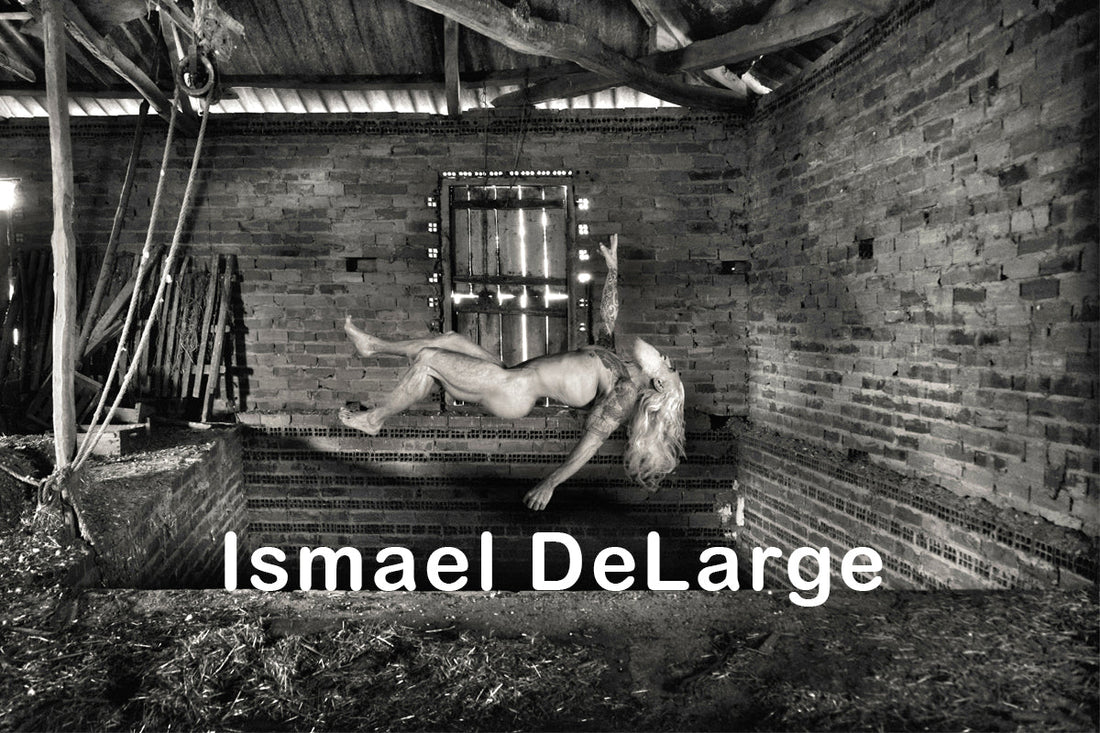
The image above is the first I encountered when reviewing his work and it really stuck with me. It exemplifies his methodological approach. Here we find a figure, muscular and exposed, positioned against brutalist architecture that was itself designed to intimidate, to overwhelm. The figure does not submit to the architecture. Instead, he asserts his presence against it, creating a kind of sculptural dialogue. The monochromatic rendering adds temporal instability to the frame, making it impossible to date the image with precision. Is this from yesterday or twenty years ago? The ambiguity is intentional. Ismael DeLarge operates outside of historical moments, creating work that feels simultaneously rooted in specific artistic traditions and somehow timeless.

The Creative World Beyond Ismael's Photography
For those unfamiliar with Ismael DeLarge's broader practice, it's essential to understand that his work encompasses far more than still photography. Ismael DeLarge has directed acclaimed arthouse short films that extend his photographic concerns into temporal space, exploring duration and performance in ways that complement and complicate his static images. He has also worked as a graphic artist, bringing his distinctive visual sensibility to page design and conceptual framing. This multimedia approach is not incidental to understanding Ismael DeLarge as an artist; it reflects a fundamental commitment to exploring his thematic concerns across every available medium. There are no secondary practices in his oeuvre. Each discipline informs the others.
The publication history of Ismael DeLarge's work tells its own story. He has published several erotic art books that function not as simple collections but as narratives, as arguments, as complex meditations on desire's relationship to image-making itself. These publications have circulated internationally, establishing Ismael DeLarge as a crucial voice in contemporary erotic art and queer visual culture. His exhibition history spans galleries and institutions across Europe and beyond, creating a parallel track to his publishing work. This is an artist who has consistently maintained control over how his work circulates, who his audience is, and what frameworks shape its reception. That level of artistic autonomy, increasingly rare in an attention economy that demands constant accessibility and platform presence, speaks to the seriousness with which Ismael DeLarge approaches his practice.
Confrontation Over Comfort
At the heart of Ismael DeLarge's work lies a fundamental question about visibility and power. By positioning queer bodies, often explicitly erotic bodies, within monumental settings or through compositional strategies borrowed from art historical tradition, Ismael DeLarge asserts that these bodies belong in the same visual register as classical sculpture, as architectural heritage, as the cultural monuments we preserve and revere. There is a politics here, but it's a politics that refuses sloganeering or simplification. Instead, Ismael DeLarge works through visual complexity, through images that contain contradictions, that refuse to resolve neatly into messages or takeaways.
This approach sometimes makes his work uncomfortable for viewers, and that discomfort is entirely the point. Ismael DeLarge has never courted comfort. His project involves challenging convention without, as the bio aptly notes, losing sincerity or elegance. That balance is harder to achieve than it might sound. Many artists working with provocative subject matter default to either didacticism on one end or pure shock value on the other. Ismael DeLarge navigates between these poles with remarkable consistency, creating work that provokes serious thought while refusing to lecture, that displays formal sophistication while remaining emotionally engaged.
The selection of Ismael DeLarge for this second anniversary edition of Inspiró feels particularly fitting. A publication dedicated to exploring queer artistic practice at its most interesting, most formally experimental, most intellectually rigorous, naturally gravitates toward artists whose work resists easy consumption. Ismael DeLarge represents the kind of artistic practice that requires time, sustained attention, and a willingness to sit with discomfort. He represents an approach to queer visual culture that asserts its right to be difficult, to be complex, to demand more from viewers than passive appreciation.


Inspiro's Two Year Anniversary
As we mark two years of Inspiró's commitment to featuring queer artists and queer perspectives in visual culture, Ismael DeLarge's work reminds us why this project matters. Not because representation alone solves anything, but because the world needs artists willing to go as deep as Ismael DeLarge goes, willing to spend years developing a singular vision, willing to refuse compromise in service of that vision. This is an artist working at the height of his powers, and his presence in these pages marks a significant moment in the magazine's ongoing mission to document the most vital work being created today.
Find more of Ismael's work online.
Website: ismaeldelarge.pb.photography
Instagram: @instagram.com/ismaeldelarge


