
Fabrizio Tiribilli Explores Imperfection as Sacred in Inspiró's Second Anniversary Issue
When an artist has stared death in the face five times and emerged with a deeper commitment to celebrating life's sensual dimensions, the resulting work carries a particular kind of gravity. Fabrizio Tiribilli, whose paintings grace the pages of the Inspiró Magazine second anniversary issue, has transformed his most profound vulnerability into a visual language that speaks directly to the body, the spirit, and the spaces between intimacy and isolation. The Florentine multidisciplinary artist does not simply paint men; Fabrizio Tiribilli paints the texture of resilience itself, creating canvases that feel less like finished objects and more like excavations into what it means to remain whole while bearing scars.

The Imperfect Surface as Gateway
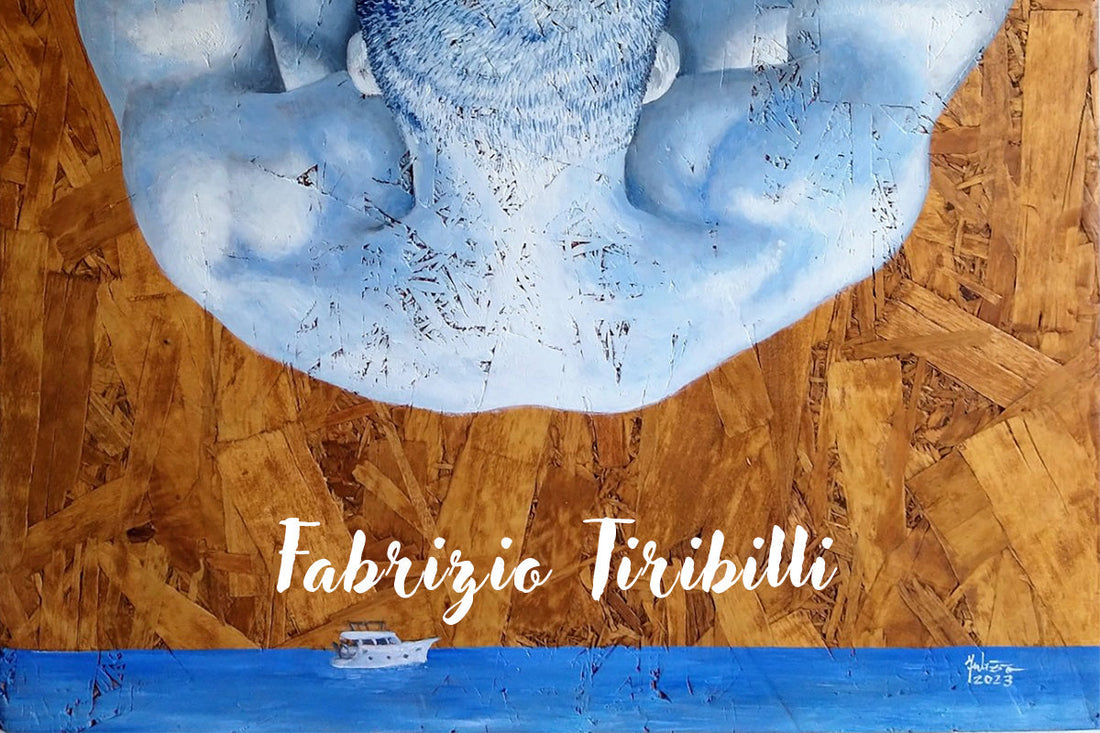
Fabrizio Tiribilli's decision to paint on OSB wood, a material made of pressed chips, reads like an artistic manifesto rendered in material form. Unlike the smooth, forgiving surface of traditional canvas, the irregular grain of OSB interrupts every brushstroke, creating fractures that splinter the human form across its surface. In the painting featured in this image, two golden male figures emerge from and merge with a luminous blue ground, their bodies rendered with an almost tactile sensuality while simultaneously fragmented by the wood's natural imperfections. Fabrizio Tiribilli has spoken about how these material choices echo his own scars, transforming what could be read as damage into something transcendent.
This approach distinguishes Fabrizio Tiribilli from artists who pursue technical perfection. Born in Florence in 1963, Fabrizio Tiribilli inherited a city saturated with Renaissance ideals about beauty and proportion. Yet his practice deliberately subverts this inheritance. In Inspiró Magazine's second anniversary celebration of fearless queer creativity, the inclusion of Fabrizio Tiribilli signals something crucial: that contemporary queer art is not interested in apologizing for its imperfections or rendering itself palatable through classical refinement. Instead, Fabrizio Tiribilli suggests that imperfection itself is a source of meaning, perhaps even beauty.

A Multidisciplinary Vision Refined
Before Fabrizio Tiribilli concentrated his practice on painting and drawing, he spent two decades working across ceramics, textile design, interior furnishings, and graphic design. This expansive training informs everything Fabrizio Tiribilli creates now. Rather than narrowing his vision, the breadth of Fabrizio Tiribilli's background provides what he describes as a transversal perspective, capable of drawing from multiple disciplines simultaneously. His time teaching art, design, and art history at institutions including the Fashion Institute of Technology in New York further deepens this pedagogical generosity evident in his work.
Fabrizio Tiribilli's education was shaped by Florence itself, his studies in contemporary art history unfolding under the mentorship of Antonio Del Guercio at the University of Florence, complemented by drawing instruction from Mary Ann Luchetti. Yet Fabrizio Tiribilli's artistic identity ultimately transcends any single school or tradition. The paintings of Fabrizio Tiribilli exist in conversation with classical depictions of the male nude while simultaneously interrogating contemporary queer visibility. In Inspiró Magazine's curation for this second anniversary issue, Fabrizio Tiribilli appears alongside eleven other international artists, each bringing their own urgent vision to the continued conversation about masculinity, desire, and representation.

Vulnerability as Artistic Territory
At the heart of Fabrizio Tiribilli's practice lies an unflinching examination of vulnerability. Having survived cancer five times along with multiple surgeries, Fabrizio Tiribilli understands the body as a landscape of survival, marked by interventions both visible and invisible. Rather than obscuring these experiences or rendering them symbolically abstract, Fabrizio Tiribilli makes them central to his visual language. The restrained palette typical of Fabrizio Tiribilli's work, dominated by muted golds, blues, and earth tones, refuses spectacle in favor of intimacy. This is a deliberate curatorial choice, one that reflects how Fabrizio Tiribilli approaches each viewer as a collaborator in meaning-making.
The featured image exemplifies this philosophy. Two figures occupy the frame with an ease that speaks to trust and interdependence. Fabrizio Tiribilli has described painting the male body as a way to express his own nature while simultaneously reconnecting with a millennial artistic tradition of depicting men with dignity and eroticism. In contemporary discourse often fractured by performative identity politics, Fabrizio Tiribilli insists that the exploration of male homoerotic desire remains as vital and complex as ever.
A Commitment to Accessibility and Visibility
In 2018, Fabrizio Tiribilli founded the Colorblindness Creativity Project, a collaborative initiative with Marco Tonucci, a colorblind Deuteranope visual artist. This project emerged from Fabrizio Tiribilli's desire to understand how colorblindness functions not as a deficiency but as a generative creative force. The resulting shift in Fabrizio Tiribilli's own practice became immediately visible: the artist now deliberately selects palettes that allow colorblind viewers to experience his paintings with the same visual clarity as those with conventional color vision. This decision reflects Fabrizio Tiribilli's conviction that accessibility and artistic vision need not exist in opposition.
The presence of Fabrizio Tiribilli in Inspiró Magazine speaks to the publication's broader commitment to amplifying voices and visions that extend beyond narrow demographic categories. The second anniversary issue celebrates this inclusive vision across its 100+ pages and carefully selected roster of international artists. Fabrizio Tiribilli belongs in this company not because he meets a quota but because his work articulates something essential about contemporary queer visual culture: the refusal to separate eroticism from humanity, desire from dignity, personal trauma from universal themes.
The Studio as Archive and Living Space
Fabrizio Tiribilli works and lives in a colonica, a traditional stone farmhouse nestled in the Tuscan hills surrounding Florence. In this space, past and present coexist without hierarchy. The kitchen retains its original fireplace, the original terracotta floors remain untouched, and the imposing cypress beams that support the roof continue their centuries-long work. Yet within this historically saturated environment, Fabrizio Tiribilli has created a studio and gallery space where drawings line the stairs like a perpetual exhibition, and paintings await new homes on gallery walls worldwide.
This dual existence, simultaneously rooted in a specific place and engaged with international art discourse, characterizes Fabrizio Tiribilli's practice more broadly. Fabrizio Tiribilli paints Florence and paints for Berlin, Provincetown, New York, and beyond. The artist's recent exhibition history includes shows in Provincetown, Massachusetts, participation in "Dirty Little Drawings" at the SoHo Project Space in New York, and exhibitions throughout Italy and Europe. Yet Fabrizio Tiribilli remains tethered to the landscape and heritage of Tuscany, drawing sustenance from proximity to olive groves, historical architecture, and the accumulated aesthetic traditions of central Italy.


Fabrizio Tiribilli in the Inspiró Moment
The decision to feature Fabrizio Tiribilli in Inspiró Magazine's second anniversary issue feels particularly resonant. Over the past two years, Inspiró has established itself as a publication committed to nuanced, unapologetic exploration of queer eros and artistic expression. Fabrizio Tiribilli's work perfectly embodies this editorial vision. His paintings refuse sentimentality while embracing profound feeling, reject pornographic cliché while celebrating sexual and sensual power, and honor vulnerability without descending into pathos.
Fabrizio Tiribilli's contribution to this issue joins work by Francesco Brunetti, Scott Mabe, Jude Ribisi, and other contemporary artists navigating the intersection of form, desire, and identity. Yet Fabrizio Tiribilli brings something distinctly singular to this conversation: a voice shaped by decades of artistic practice, informed by classical training yet committed to contemporary relevance, and ultimately rooted in a philosophy that sees imperfection not as failure but as redemption.
When you encounter the work of Fabrizio Tiribilli in Inspiró Magazine's pages, you are meeting an artist at the height of his powers, one who has transformed personal devastation into a practice of profound celebration. Fabrizio Tiribilli does not make art about mortality in order to transcend it; rather, Fabrizio Tiribilli makes art that insists on the continuous, everyday miracle of remaining alive, connected, and capable of creating beauty. In a cultural moment that often demands either resignation or denial, the paintings of Fabrizio Tiribilli offer a third path: the ongoing transformation of wound into meaning, fragmentation into wholeness, and imperfection into truth.
Find more of Fabrizio's work on his website fabrizio-tiribilli.com and follow him on Instagram @fabrizio_tiribilli


