
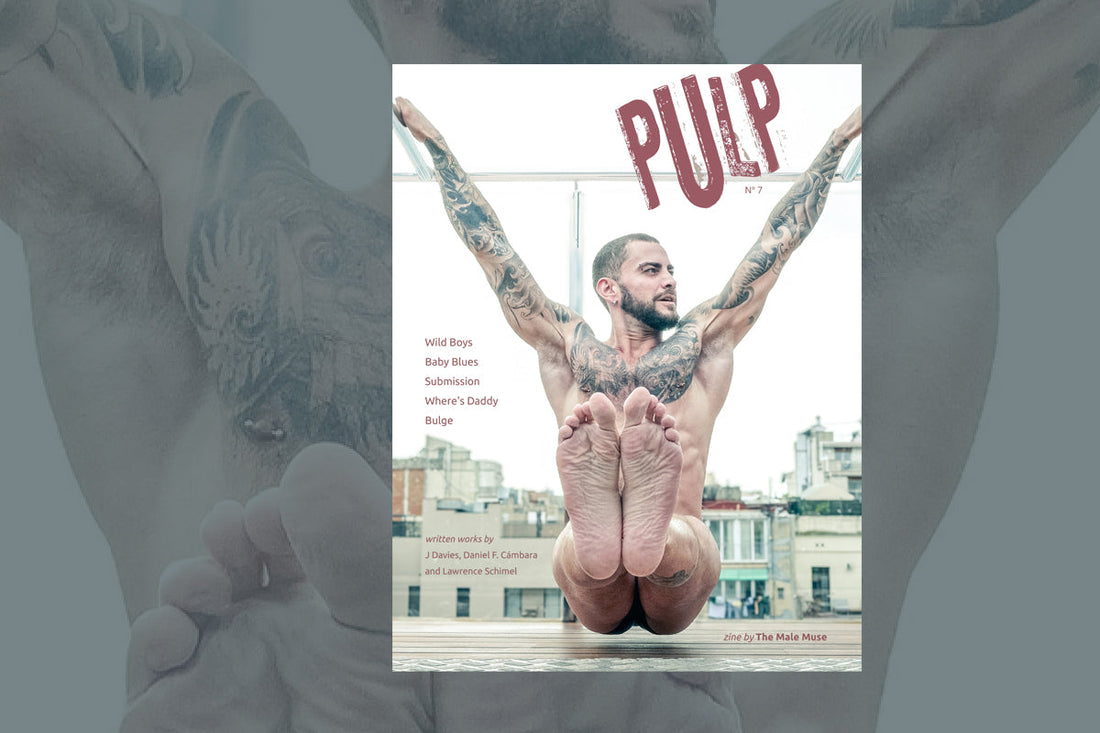
Raw, Unfiltered & Unapologetically Queer: Pulp Issue 7 is Here
For those already acquainted with Mark Alan's limited-edition queer photography zine, the arrival of a new issue is an object that arrives in a plain envelope and opens into something bold, sensual, and alive. For those discovering it for the first time, welcome. You've found something worth knowing about.
Issue 7 is here, and it may well be the most daring, thematically charged edition yet. Fifty satin-finished pages. Five photographic spreads. Three queer writers whose work charges each image with language as provocative and precise as the photography itself. And only 100 copies in existence — ever.

What Is Pulp?
Pulp was born from the vision of Mark Alan, an American photographer now based in Spain, and the creative force behind The Male Muse. Pulp is his zine: a deliberately intimate, limited-run publication that pairs his photography of the male form with writing by queer voices from across the literary world. Each issue is distinct. Each issue is destined to sell out. And none is ever reprinted.
Having worked behind the camera for over two decades, beginning with fashion, portraiture, and architecture studies in Los Angeles, Mark has honed a practice that moves with total fluency between fine-art restraint and the explicit. Living in Europe opened new creative territory. "In the past, while living in the US, I hadn't really thought about bringing fetish and kink themes into my work," he has said. "Now living in Europe and collaborating with models who are also into the scene, it's been very liberating to express my fantasies through them." That liberation pulses through every page of Issue 7.
"Each issue of Pulp is limited to 100 copies, printed once, and never reprinted. When it's gone, it's gone."
Inside Issue 7
Five spreads. Five distinct registers of desire. Issue 7 leans hard into fetish, sexual power play, and queer sensuality, touching his interests including feet, armpits, socks, bondage, and the charged theatre of domination and submission. This is not voyeurism at a remove. Mark Alan shoots with intimacy and intention, and the men in front of his lens are collaborators, not subjects.
Spread 01 - Wild Boys

The issue opens with an electric pairing: Spanish porn star Kosta Viking alongside his handsome friend Emanuel. The chemistry between them is palpable, two men comfortable in their bodies and in each other's orbit. Playful, charged, and undeniably hot, Wild Boys sets the tone for everything that follows: unapologetic, joyful, and brazenly queer.
Spread 02 - Baby Blues

Meet Marc, an inked, hairy, tattooed muscle stud from Barcelona. This spread is a masterclass in texture and contrast: the softness in his gaze against the hard architecture of his body, the intimacy of the frame against the boldness of his presence. Baby Blues is the kind of photography that combines art and vintage beefcake vibes.
Spread 03 - Submission

The most visceral sequence in the issue. London sub Spencer has agreed to be bound and gagged for Mark's camera, and the results are dark, edgy, and transfixing. Shot with the same care and artistry that defines Alan's work, Submission explores the erotic theatre of control and surrender. It is consensual, it is beautiful, and it does not flinch. For those drawn to the aesthetics of kink and BDSM, this spread alone is worth the price of admission.
Spread 04 - Where's Daddy

Bearded Spanish OnlyFans model Danny Delgado brings an easy, masculine charisma to the zine's fourth spread. For lovers of sports socks, you'll admire Danny's knee high pair blazened with the word VERSA. There is warmth here alongside the heat, a sense of personality and play that makes Where's Daddy one of the most charming sequences in the issue. Fetish with a wink.
Spread 05- Bulge

The issue closes, audaciously, with Hung Berlin Guy, first caught in a jockstrap before stripping down and releasing what the title describes, without hyperbole, as his pierced monster. Bulge is brash and unapologetic, a finale that leaves no ambiguity about what kind of magazine you're holding.
The Writers
What separates Pulp from other erotic photography publications is the quality and seriousness of its literary contributors. Issue 7 brings together three queer writers, established and emerging, whose words sit alongside, not beneath, Mark Alan's images.
Lawrence Schimel
Lawrence Schimel is one of the most prolific and widely translated queer writers working today. A bilingual author and anthologist based in Madrid, Schimel has contributed to an extraordinary range of literary publications and anthologies across multiple languages. His presence in Pulp signals the zine's ambition clearly: this is not supplementary text, but genuine literary work from a writer of international standing.
J Davies
J Davies brings a distinctive voice to Issue 7, one of the queer writers whose work in this issue weaves between the autobiographical and the fantastical, grounding the visual world of the spreads in language that is both precise and evocative. Their contribution speaks directly to the erotic charge of the photographs while carving out its own literary territory.
Daniel F. Cámbara

Daniel F. Cámbara rounds out the trio of contributors, adding a voice that extends the thematic reach of the issue. His work brings texture and narrative complexity to the visual world Mark Alan has constructed, writing that rewards slow reading as much as the photographs reward slow looking.
Why It Matters
We live in a moment when queer erotic imagery is simultaneously more accessible and more precarious than ever before. Algorithmic moderation strips explicit content from mainstream platforms; apps and social networks quietly throttle queer visibility. Against this backdrop, the printed zine is not a nostalgic gesture, it is a political one.
Pulp exists outside those constraints. It is a physical object: something you can hold, dog-ear, return to. It cannot be shadowbanned. It will not disappear behind a content warning. And unlike the infinite scroll of online imagery, it has an end, and a beginning, which forces a different kind of attention. You sit with it. You look properly.
The queer literary and visual tradition has always found ways to persist in physical form when digital spaces become hostile. Pulp is part of that lineage, one that runs from early homophile publications through the zine boom of the 1980s and 90s, to the small-run independent publications that define today's most interesting margins of queer culture. Mark Alan is not simply making a product. He is making an artifact.
One hundred copies. No reprints. Issue 7 is, by design, ephemeral. Part of its value is its disappearance, the fact that in time it will exist only in the collections of those who moved quickly enough to get one.


