
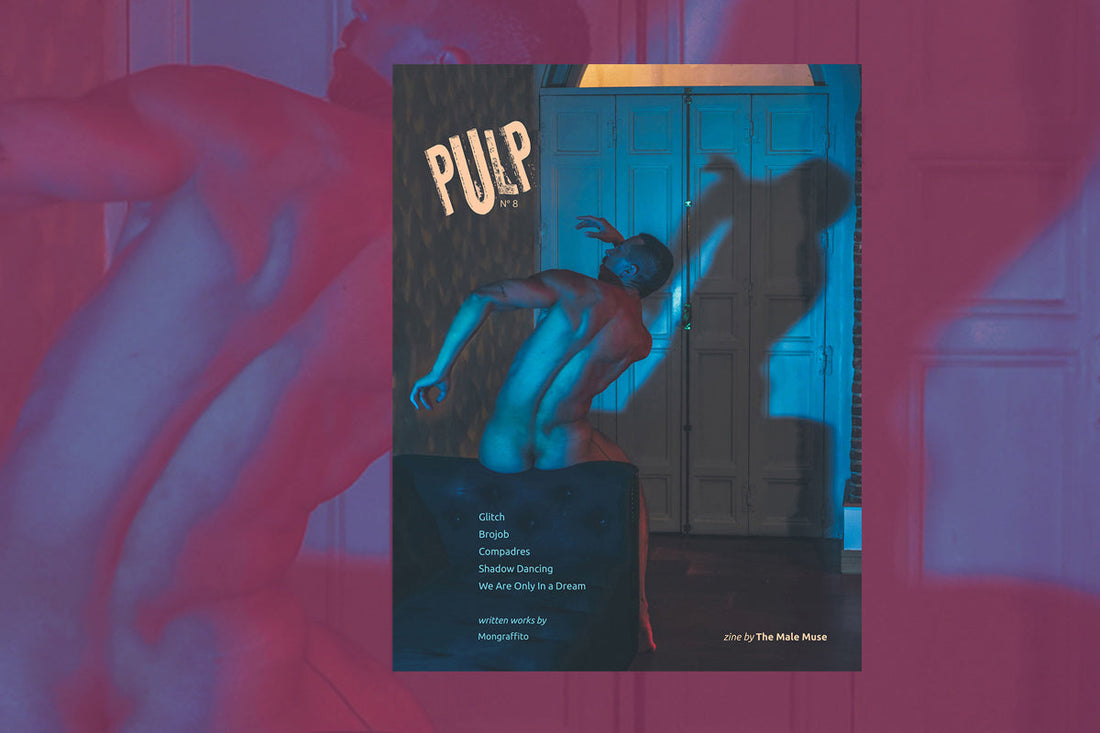
Raw, Bold, and Unapologetically Queer: The Ever Developing World of Pulp Magazine
Now eight issues deep, Pulp Magazine is one of the most distinctive queer art publications operating in independent print today. It is the creation of Mark Alan, an American photographer now based in Spain, whose career spans more than two decades behind the lens. The zine brings together his male nude photography with writing by queer authors, producing something that feels genuinely rare in the current publishing landscape: a collaboration between image and word that neither illustrates the other, but instead inhabits the same charged space.

What Is Pulp Magazine?
Pulp magazine is a limited-edition softcover zine, printed to just 100 copies per issue, on satin-finish pages that give the photography the weight and warmth it deserves. It is published through The Male Muse, Mark Alan's personal platform devoted to homoerotic art, editorial, and photography.
The concept is deceptively simple. Each issue pairs a sequence of photographic spreads: male nudes, intimate, often explicit, with writing by queer authors who respond to, reflect upon, or exist alongside the images. Past contributors have included poets, essayists, and erotic writers from across the queer literary world, among them Richie Hofman, Jim Whiteside, Lawrence Schimel, and Dale Booton. The writing is never mere caption. It carries its own desire, its own argument, its own fever.
What distinguishes Pulp Magazine from the broader world of erotic photography publishing is its insistence on artistry. Mark Alan trained in photography with a focus on architecture before turning to the male form, and that formal sensibility has never left his work. His early career in Los Angeles shooting fashion left what he describes as an "editorial vibe" that still surfaces in his images. There is always a compositional intelligence at work, a knowledge of light, space, and body that stops the images from being merely explicit and makes them genuinely beautiful.

Mark Alan: The Eye Behind the Lens
Mark Alan's journey to Pulp Magazine is one of those creative biographies that feels inevitable in retrospect. Raised in a small farming community near Seattle, he was drawn outward from an early age, restless, curious, with what he calls a "wanderlust" that has shaped everything since. After studying photography in Los Angeles, he spent years focused on work outside the artistic sphere before eventually reclaiming his passion and relocating to Spain, where the light, the culture, and a new community of collaborators gave his practice renewed energy.
The Male Muse, the platform, the ethos, the ongoing project, grew from this return. It is a space, as he has described it, where he expresses himself "by working with models to photograph everything from implied nudes to more explicit erotica, but always with a sense of artistry to capture the beauty of the men before my lens." Pulp Magazine is the most focused expression of that vision: intimate in scale, uncompromising in content, and deeply considered in its curation.
The models who appear in Pulp Magazine are not anonymous bodies. They are collaborators, men from both sides of the Atlantic, from Madrid apartments to Los Angeles bedrooms, whose individuality Mark consistently finds and preserves through his lens. Spain, where he now lives and works, has become a particularly generative creative territory. European collaborators who share his interests in fetish, kink, and uninhibited self-expression have allowed his work to go places it could not before.

Pulp Magazine, A Publication That Evolves
What makes Pulp Magazine compelling as a series rather than simply a publication is its willingness to change. Each issue has its own mood, its own collaborators, its own aesthetic commitments. Early issues leaned into the erotic editorial tradition, warm, sensual, literary. Later issues have grown increasingly experimental, with Mark using Pulp Magazine as a space to push his visual language in new directions.
Pulp Magazine Issue 3 brought a gallery of Spanish and British models into intimate interiors, with poetry to match. Pulp Magazine Issue 4 worked with prominent gay poets including Richie Hofman and Jim Whiteside alongside photographs of men on both sides of the Atlantic. Pulp Magazine Issue 6 expanded the literary roster to four writers, explored fetish themes more directly, and introduced a wider range of visual scenarios, from kink-inflected studio work to sun-drenched everyday intimacy.
By Pulp Magazine Issue 8, the series has arrived at something genuinely new.

Issue 8: The Most Experimental Pulp Magazine Yet
Pulp Magazine Issue 8 pairs queer erotic writing by Mongraffito with a set of photographic spreads that represent the most formally ambitious work Mark Alan has done within the series to date. Where previous issues of Pulp Magazine balanced explicit content with a relatively classical photographic approach, Issue 8 tilts sharply toward experimentation, using digital manipulation, light abstraction, and composite techniques to ask new questions about what the male body can become in an image.
The spreads across this issue are each distinct in tone and method.
"Glitch" is exactly what it sounds like, and more. Mark has assembled over 100 images, fragmenting and recombining them into a chaotic environment of coloured blocks. The result is a kind of visual deconstruction: bodies broken apart and reassembled in new geometries, desire rendered as data, flesh becoming pattern. It is the most conceptually daring thing Pulp has published.
"Brojob" shifts into something rawer and more narrative. Straight OnlyFans model Ivan Hard and his gay companion Nando Rey are the subjects, and the dynamic between them, the frisson of crossing a line, the casualness and the charge of it, is exactly the kind of queer sexual energy Pulp Magzine exists to document honestly, without apology or editorial softening.
"Compadres" is a continuation of Mark's ongoing illuminated series, this time featuring models Kiray and Luke Santana. The illuminated work uses light as both subject and atmosphere, bodies caught in radiance, the photograph itself becoming something slightly sacred and slightly dangerous.
"Shadow Dancing" offers the issue's most lyrical passage: Spanish dancer Estefan, photographed moving through a Madrid apartment, his body in conversation with shadow and space. There is something dreamy and melancholy about this spread, a quality of reverie that sits in productive tension with the more explicit work elsewhere in the issue.
And then there is "We Are Only In a Dream", the spread that gives the issue its title and its emotional centre. Here, Mark has overlaid male nudes with abstract patterns of light, allowing the bodies to recede, to become secondary, at times barely discernible. It is an unusual choice for an erotic publication, and a brave one: to make the body into something ghostly, to suggest that desire itself might be a kind of dissolution. It is the most experimental Mark has gotten, and the result is quietly stunning.

Why Support Pulp Magazine
Independent queer publishing has always existed in tension with the mainstream, producing what mainstream culture either cannot accommodate or chooses not to. Pulp Magazine sits squarely in that tradition. It is the kind of object that physical print makes possible and digital distribution cannot replicate: something you hold, something with a specific weight and texture, something limited to exactly 100 copies of Pulp Magazine that will not come back once they are gone.
In an era when so much queer visual culture is filtered through the logic of social media, cropped, flagged, suppressed, or algorithmically smoothed into palatability, Pulp Magazine is a deliberate act of resistance. It exists in the physical world, outside the platform, on its own terms.
For collectors, it is already an established quantity. Each issue is destined to sell out. For newcomers, Pulp Magazine Issue 8 represents an excellent entry point: it captures Mark Alan at a moment of genuine creative evolution, pushing past the already accomplished work of earlier issues into something more uncertain, more exploratory, and more artistically alive.
Get Your Copy of Pulp Magazine
Pulp Magazine Issue 8 is a limited print edition of 100 copies, available in The Male Muse Store. A digital edition is also available. Once the print run is gone, it will not be reprinted.
If you are new to the series, back issues, where available, are worth hunting down. But start here, with Pulp Magazine Issue 8, with the glitch and the dream and the dancer and the light, and see what it is that Pulp Magazine is becoming.


