
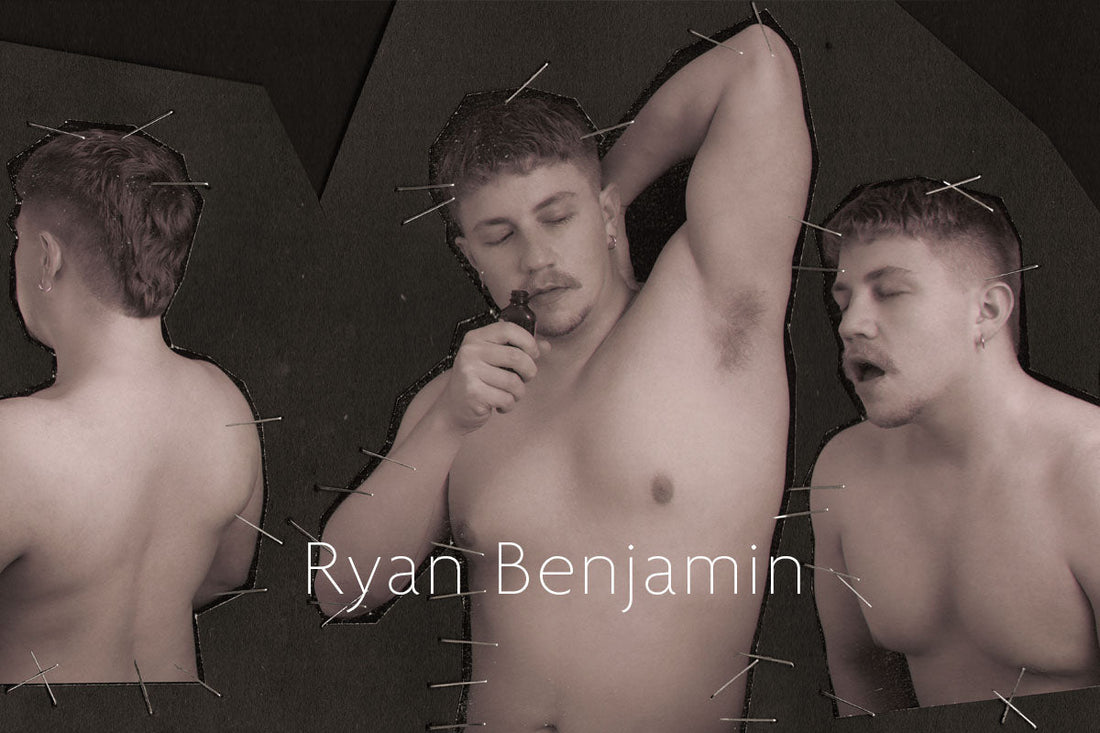
God Made the Body, Ryan Benjamin Made It Interesting
There is something almost liturgical about the way Ryan Benjamin handles his own image. He appears in frame not as subject but as offering, a willing sacrifice to the twin altars of desire and critique. His body is the medium. His camera is the confessional. And whatever comes out the other side is something the Church, the gallery establishment, and your conservative relatives would collectively rather not discuss at dinner.
Which is exactly the point.
Benjamin, now working out of Brooklyn, New York, came up in Jacksonville, Florida, a place not historically renowned for its hospitality toward queer kids with a taste for the provocative. He came out in conservative surroundings, watched his family fracture through divorce, and instead of letting that wreckage fossilize into something quiet and private, he turned it into fuel. His self-portraiture practice, which he began documenting publicly through his Instagram alter-ego @stupidinspace, became a kind of ongoing performance art, a persona built to contain his projections, his desire, his grief, and his extraordinary, deadpan wit.

Look at "The Sun and His Lover the Moon," the image that appears in Inspiró Issue 4. Two shirtless male figures frame a black void of a sky, their human bodies soft and warm and entirely real. But their heads have been replaced by celestial bodies: one man wears a radiating, golden sun, molten and spiky, his face pressed into the center like a coin in wax. The other wears the moon, a pocked and luminous disc, gravity-heavy, cratered with intention. Between them, a toy rocket hangs from a string, dangling in space with the absurd nonchalance of something that knows it does not belong but has decided to be there anyway. They reach toward each other, barely touching, a gesture both tender and teasing.
This is classic Benjamin. The image is funny, genuinely funny, in the way that only deeply sincere art can afford to be funny. It is also unmistakably erotic. The bodies are present, tactile, and unapologetically fleshy in a way that refuses the sanitized ideal. There is chest hair. There is weight. There is the specific charge of two men reaching across an impossible distance to make contact anyway. The cosmic kitsch does not undercut the longing; it amplifies it. Love as mythology. Desire as cosmology. Two men who are somehow the sun and the moon, which is to say, two men who cannot exist at the same time in the same sky without the whole world taking notice.

Benjamin has spent over a decade building this language. His foundation in digital photography, sculptural practice, and black-and-white printmaking gives his work a material consciousness rare in the age of the instantly filterable image. He does not simply capture; he constructs. His compositions borrow from religious iconography, from the grand theatrical tradition of history painting, from the camp register of mid-century kitsch, and from the raw honesty of queer autobiographical art. The result is work that operates simultaneously as seduction and critique, asking you to want the image while also making you think about why you want it and what society has told you about wanting things like this.
His Instagram, which he frames as a site for "a false persona where personal projections can be displayed," is itself a conceptual project, a commentary on the theater of online identity in the age when selfhood has become a kind of product. Benjamin puts himself in the frame, repeatedly, insistently, but the self he offers is always slightly tilted. He is not confessing; he is performing confession. There is a crucial difference, and he knows it.

That play between revelation and construction is what makes his contribution to Inspiró Issue 4 land so well alongside the magazine's broader celebration of queer desire. This anniversary edition, gathering twelve artists across 112 pages of premium matte print, has always understood that homoerotic art is not a single frequency but a full spectrum: raw and refined, playful and devastating, political and purely sensual. Benjamin brings all of those registers at once. His images are not simply images to look at. They are positions to take, questions to sit with, and, if you are doing it right, bodies to want.
There is something almost unbearably human in the celestial lovers reaching toward each other and not quite getting there. That gap. That suspension just before contact. That is where all of Benjamin's best work lives: in the space between desire and its satisfaction, between the wound and the wit that dresses it, between the body you were given and the icon you decide to make of it.

Inspiró Issue 4 is available now through The Male Muse store. Ryan Benjamin's work and prints are available at ryanbenjaminphotography.com and he continues his singular performance of self at @stupidinspace on Instagram.
Get your copy of Inspiró Issue 4, the anniversary collector's edition, at themalemuse.store. 112 pages. 12 artists. Absolutely no apologies.


