
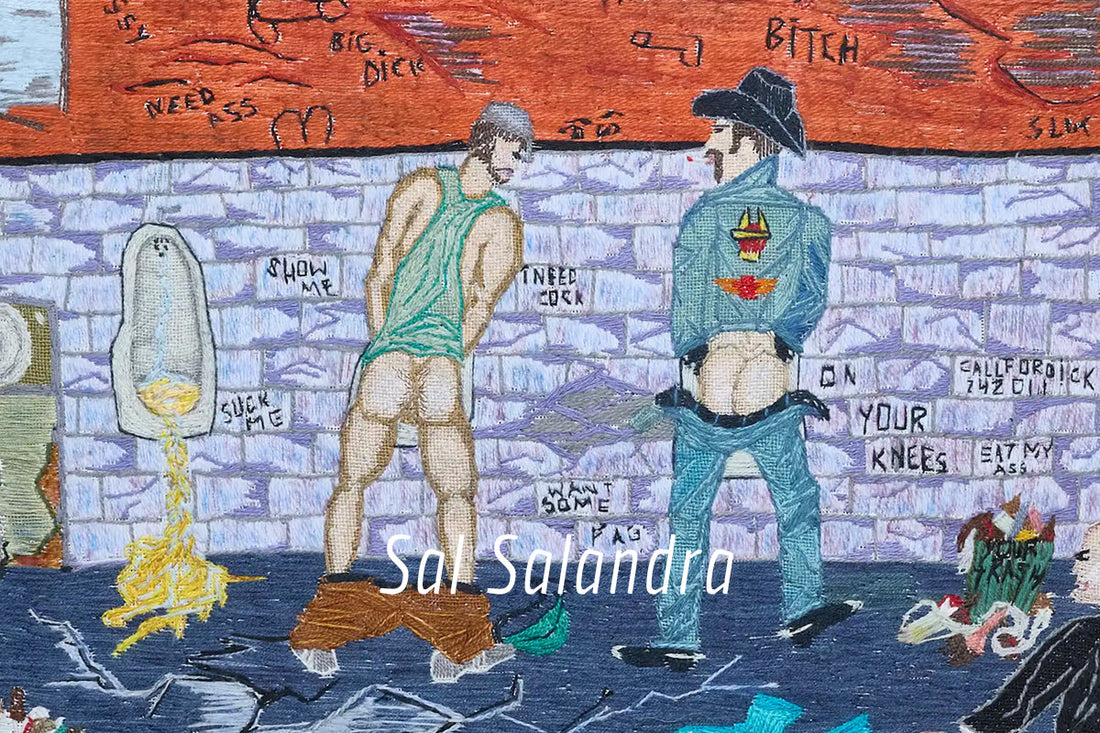
Thread and Desire: Sal Salandra Takes the Dungeon in SNIFF's Second Scent
There is a particular kind of art that does not ask permission. It does not negotiate with taste-makers, tiptoe around its subject matter, or soften its edges for a mainstream audience. It simply exists: vivid, unapologetic, and completely itself. Sal Salandra makes that kind of art which is perfect for the second issue of SNIFF.

The 79-year-old, self-taught artist from East Hampton, New York has been refining his singular vision for over four decades, working almost daily in a medium most people associate with holiday ornaments and suburban living rooms. Needlepoint. Or as Salandra insists on calling it: thread painting. The distinction matters. Where traditional needlepoint follows a pattern, Salandra draws his own. Where traditional needlepoint decorates, Salandra narrates. And what he narrates is a world teeming with leather daddies, bondage gear, Catholic imagery, pop culture icons, and the full-throated joy of gay erotic life.
SNIFF Magazine's Second Scent is proud to feature Salandra's work, and it is a pairing that feels not just fitting but inevitable.

From Hairdresser to Thread Painter
Salandra spent 55 years as a hairdresser in New Jersey, a career that sharpened his eye for detail and gave him decades of intimate observations about people and performance. He is a second-generation Italian-American, raised devoutly Catholic in Englewood, New Jersey, one of seven children. He once considered the priesthood before his severe dyslexia redirected that path. He eventually came out, found his husband, and built a life in Manhattan's West Village before the couple relocated to East Hampton, where he has lived for the past 27 years.
The needlepoint began in the early 1980s, a gift from his mother-in-law during a period of being bedridden with a back injury. "I thought: what am I going to do with this?" he has said. But something clicked. He fell in love with the way thread could literally paint a picture in front of his eyes as he sewed. He has not stopped since.
For many years, he worked on traditional motifs: animals, florals, still lifes. Then, around 2015, a commission from a gallery owner in Los Angeles asked him to try something more explicit. A BDSM-themed canvas. Salandra obliged, and something unlocked. The erotic thread paintings that followed have made him one of the most discussed names in queer art.

A World Unto Itself
To look at a Salandra canvas is to step into a world operating by its own internal logic. His large-scale compositions are densely packed with figures, objects, and scenes that unfold simultaneously, less like a single image and more like a tapestry of interconnected moments. Critics have compared his visual structure to Hieronymus Bosch's chaotic visions, to the flat pseudo-perspectives of medieval miniature painting, and to the erotic illustrations of Tom of Finland. All three references land.
He-Man in the Dungeon (2024), the piece featured in this issue and reproduced here, is a perfect introduction to his sensibility. The teal-brick dungeon thrums with activity: a leather-harnessed figure tends to a blonde in red boots reclining on a bench, bodies hang suspended from ceiling hooks, implements line the walls, and scattered across the floor is a collection of toys, tools, and inexplicable objects (bowling pins among them) that introduce a note of pure absurdist comedy into an otherwise very serious scene. Salandra's dungeon is a place where kink is sovereign, but so is play. Nobody here is grim about any of this. That lightness, that sense of fantasy made tactile, is among the most distinctive qualities of his work.
Each figure is rendered with a tenderness that feels almost devotional. The musculature, the weight of skin against restraint, the specificity of each harness strap and boot buckle: Salandra observes bodies the way old masters observed saints. His craft is meticulous. He has developed his own proprietary stitches over decades, including the elongated stitch, blind lock stitch, curve stitch, and save color stitch, techniques born from the specific demands of rendering erotic imagery in thread. The result pushes the medium well past craft and into the tradition of epic storytelling more commonly associated with medieval tapestry.

Sex, God, and the Iron Halo
Salandra is not shy about the theological dimension of his work. He draws a straight line between the pain and submission embedded in Catholic tradition and the rituals of BDSM. "The Catholic Church is one of the largest BDSM groups in the world," he has said, "there's so much torture and pain in Catholicism." His canvases bear this out: priests and leather daddies share the same symbolic register. A can of Crisco can read as sacred oil. A ball-gag becomes a meditation on the restriction of speech and the power of silence.
There is also something deeply personal at work. Salandra describes the act of sewing itself as a form of prayer, the meditative repetition of pulling thread through canvas not unlike the rhythm of a rosary. He works roughly twelve hours a day. He has said that God speaks to him while he works, guiding color choices and compositional decisions. Whether one takes that literally or metaphorically, it speaks to the depth of focus and intention he brings to each piece. These are not casual provocations. They are sincere.
Queering a Craft
Part of what makes Salandra's work so resonant is the deliberate tension between medium and subject. Needlepoint is coded as domestic, feminine, heteronormative. It lives in the world of throw pillows and Christmas stockings. Salandra has taken those materials and techniques and queered them entirely, using them to document BDSM fantasies, leather community life, and homoerotic desire with the same care another artist might bring to a portrait commission. He has, as critics have noted, successfully reclaimed the medium, opening a new space within it that is both inclusive and honest, returning it to the tradition of storytelling it once occupied before it was domesticated.
His work has been exhibited internationally, shown at the Outsider Art Fair in New York, the Tom of Finland Foundation, and gallery spaces including Club Rhubarb in Manhattan. He has been featured in Artforum, GQ, It's Nice That, the Brooklyn Rail, and a growing list of publications that recognize the ambition and originality of what he is doing.

Why SNIFF
SNIFF Magazine exists precisely for artists like Sal Salandra. This publication was built on the conviction that fine art and fetish culture are not opposing forces but natural collaborators, and that queer erotic art deserves serious attention alongside serious craft. Salandra embodies that proposition completely. His work is both sexually explicit and formally accomplished. It is rooted in personal experience and community, in spirituality and desire, in the specific textures of a queer life lived fully and without apology.
Second Scent continues the conversation that Scent One began: that unapologetically queer, kink-affirmative art belongs not at the margins of culture but at its center. Salandra's thread paintings make that argument in vivid color, one stitch at a time.
Pick up your copy of SNIFF Magazine Scent Two and see the full spread of Sal Salandra's work in print and in all its glorious detail.
You can find out more about Sal on his website salsalandra.com


1 Comment