
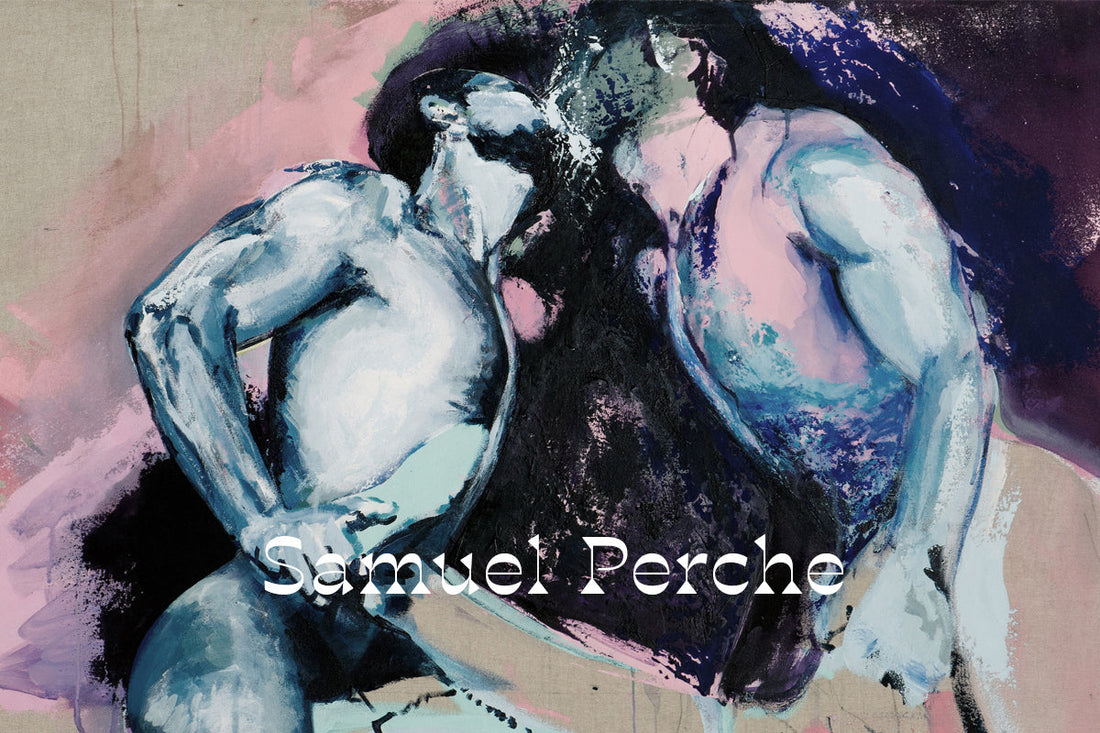
Queer Desire Expressed Without Hesitation
Brittany's coastline is not the first place you'd expect to find a reckoning with gay desire this raw, but that's exactly where Samuel Perche paints it. Samuel Perche's work is featured in Inspiró Issue 2, and it announces itself with the kind of confidence that doesn't ask for permission. Samuel Perche paints men who are sweating, straining, offered up and unapologetic, and he does it with a hand that has spent years learning how bodies hold history.

From the Stage To the Canvas: Samuel Perche and His Journey To Creating Queer Art
Before he picked up a brush, Samuel Perche was an actor, spending time on French stage and television. That chapter closed when he moved to La Réunion, the French island in the Indian Ocean, where he spent a decade rebuilding his practice from the ground up. Samuel Perche graduated from the National School of Arts there and began mounting his own exhibitions, working simultaneously as a painter and a sculptor. It was on that island, far from Brittany, that Samuel Perche found the language he now speaks fluently, bodies rendered thick with muscle, color, and unresolved tension, standing in for something much larger than the men depicted. Ten years is a long apprenticeship for anyone, but for an artist rebuilding an entire practice from acting into painting and sculpture, it shows in the confidence of the work. Nothing about Samuel Perche's men looks tentative.
Now back in Brittany where he was born, Samuel Perche has turned his attention to what he calls an act of repair. "If identity necessarily has to do with body experience," he says, "revealing the intimacy of gay desire becomes a new paradigm to question that which has been silenced or made invisible in gay identity." That sentence could sit quietly in an artist's statement, but in Samuel Perche's paintings it detonates. His men are not decorative. They are built like arguments, muscle and shadow doing the work of making visible what gay identity has historically been asked to hide. There's nothing coy in the way Samuel Perche approaches the male body. He paints it the way other artists might paint a landscape they know intimately, with total familiarity and zero hesitation about showing you every ridge of it.

This is the throughline of his MAN·MEN series, the body of work Inspiró Issue 2 draws from. Samuel Perche takes the male form, already loaded with centuries of classical reference, and floods it with color choices that read as almost confrontational, pinks and blues pulled straight from gender stereotype and turned inside out. The gay body becomes fantasy and landscape at once, muscle rendered so vividly it looks sweated into the canvas. Desire isn't hinted at here. It's the entire subject, treated as something worth building a whole aesthetic around rather than softening for comfort. Samuel Perche's men lock eyes with the viewer, or turn away in postures that read as both vulnerable and commanding, and either way the effect is the same: you are not looking at a passive object. You are looking at a body that knows exactly what it wants and isn't interested in your comfort level.
Samuel Perche's sculptural work follows the same instinct, though with a different material logic. He builds monumental figures out of reclaimed pallet wood, a material with none of the polish of Renaissance marble and all of the urgency of something scavenged to survive. One piece reworks Michelangelo's David. Another reimagines Canova's Psyche as two men. A third, arched and straining toward the sky, draws from the image of a migrant who died at sea, a reminder that Samuel Perche's version of masculinity carries grief as easily as it carries lust. Poetic and political sit in the same gesture, which is exactly how he wants it. Working in salvaged wood rather than bronze or stone is its own statement too, a refusal of the material language typically reserved for heroic male bodies in Western art history, swapped out for something rougher and more honest about what it took to build.

Samuel Perche and Inspiró Magazine
What makes Samuel Perche's contribution to Inspiró Issue 2 land so hard is the refusal to separate beauty from politics. Plenty of artists paint the male form as pure aesthetic pleasure, and plenty of others make work that is politically pointed but visually cold. Samuel Perche does both at full volume, simultaneously. His paintings are unmistakably erotic, built to hold your gaze on muscle, sweat, and skin, and they are also doing the work of insisting that gay desire has been erased from public visual culture for too long and deserves to be seen exactly as intensely as it's felt. That combination, poetic and political, sensual and unflinching, is precisely why Inspiró Issue 2 makes room for Samuel Perche's work alongside its lineup of queer visual artists.
This issue exists to gather artists who treat male beauty as territory worth exploring seriously, not just displaying, and Samuel Perche's paintings do both at once. They invite you to look at desire directly, without the usual apologies, while insisting that desire itself is doing political work. There's a confidence to how Samuel Perche paints that feels earned rather than performed, the kind that only comes from a decade spent building and rebuilding a practice from scratch, far from home, before bringing it all back to the place he started.
You can see more of Samuel Perche's paintings and sculpture on his website and follow his newest pieces on Instagram. Inspiró Issue 2, featuring Samuel Perche's work alongside eleven other queer visual artists, is available now through The Male Muse store.


