
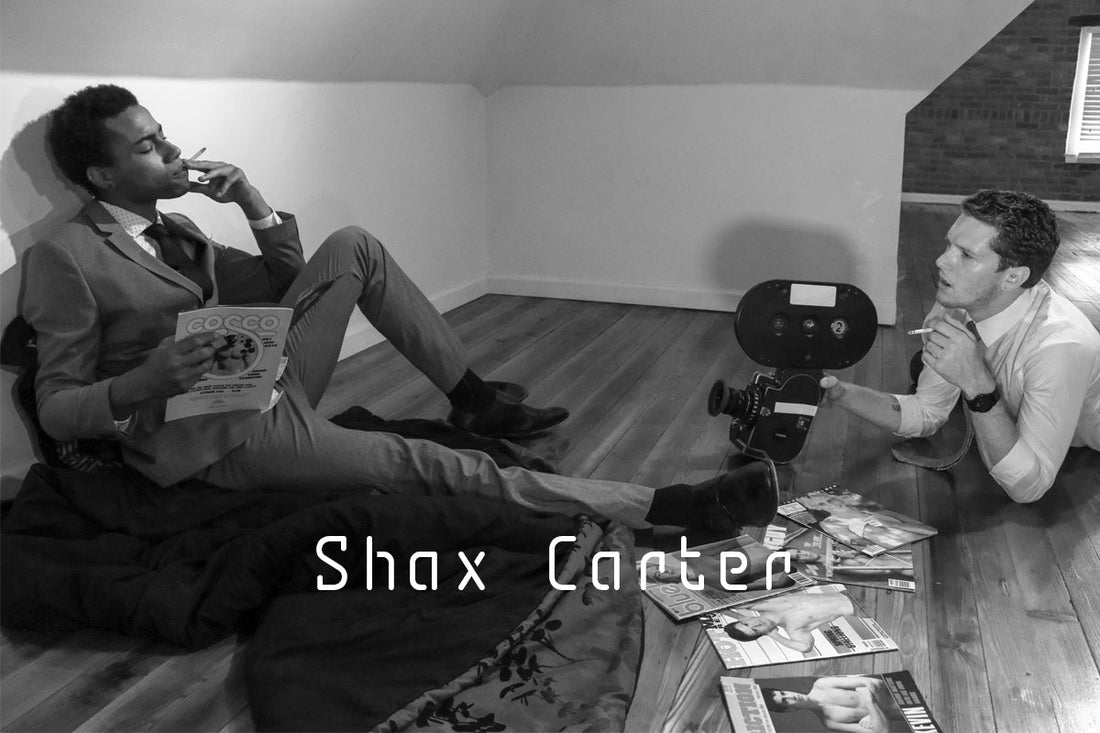
Shax Carter Brings a Modern Queer Take on the American West Aesthetic
In Los Angeles, where the mythology of the American West persists in peculiar and often ironic ways, Shax Carter has built a visual practice around desire, intimacy, and the male body. His photographs, featured in Inspiró magazine's second anniversary issue, offer something refreshingly direct: an uncompromising gaze at male sensuality rendered through color film, natural light, and a compositional language that feels both cinematic and confessional.
Shax Carter's work doesn't whisper. It occupies space with the kind of ease that comes from decades of looking, first through a cinematographer's lens and now through the more intimate frame of one-on-one portraiture. His subjects recline, pose, and inhabit moments of vulnerability with the kind of relaxed confidence that only emerges when a photographer genuinely understands the power dynamics at play. There's no performance anxiety in Shax Carter's images, no stiffness. Instead, there's a quality of discovery, as if both photographer and subject are participating in an act of mutual vision.

The editorial sensibility Shax Carter brings to male portraiture is distinctive precisely because it refuses easy categorization. His images are undeniably erotic, yet they're never crude. They're deeply personal, yet they read as universal. There's humor embedded in the styling, vulnerability in the composition, and a distinctly queer gaze that acknowledges desire without apology. When a subject wears white socks and a cowboy hat in a bedroom scene, Shax Carter photographs it as neither camp nor kitsch, but as authentic style, as real desire, as the genuine aesthetic choices of a real person.
For a photographer who identifies as shy and withdrawn, Shax Carter's work functions as a kind of visual courage. In his own words, he uses the lens to express desire, to give viewers a window into his vision. This is an important distinction. He's not documenting desire neutrally; he's expressing it. The photographs carry his fingerprints, his taste, his longing. They're authored works, not neutral recordings.

From the Countryside To the Streets of Los Angeles
The geography of Shax Carter's practice is equally intentional. Los Angeles and the American West provide more than backdrop here. They're ideological territories. The West, in American visual culture, has always been coded as masculine, rugged, untamed. Shax Carter's photographs reclaim and reframe that geography through a queer lens. The cowboys and cowboys-adjacent subjects who populate his portfolio are not straight archetypes; they're queer men claiming space within a landscape that has historically excluded them. A man in cowboy boots and minimal clothing isn't a novelty or a fetish object in Shax Carter's visual language. He's a legitimate inhabitant of this terrain, as much a part of the Western landscape as anyone else.
This reclamation is subtle but profound. Shax Carter doesn't announce his politics through didactic imagery or heavy-handed symbolism. Instead, he works through the language of beauty itself. His subjects are beautiful. They're photographed with genuine admiration. That admiration comes from a queer man, shaped by decades of looking, of loving, of understanding the male form as worthy of attention and celebration. The political statement emerges naturally from the aesthetic choice.

From Cinematography To the Still Image
Shax Carter's transition from cinematography to photography was driven by a desire for greater intimacy. Thirty-five millimeter black and white film, he's noted, was a wonderful format for capturing the male figure in motion. But stillness, quietness, and the one-on-one relationship that photography affords, offered something different. Less equipment meant fewer obstacles. It meant the camera could disappear, or at least recede, allowing for genuine connection between photographer and subject. It's a philosophy that shows in every frame. Shax Carter's photographs feel collaborative even when they're clearly authored by a singular vision.
The work featured in Inspiró's second anniversary issue represents not a departure from what Shax Carter has been doing, but a deepening of it. His portfolio continues to expand, his vision continues to sharpen, and his influence within queer artistic communities continues to grow. His photo book "Billy," now available through his Blurb store, extends this work into a longer-form narrative, allowing viewers to spend sustained time with his visual language.
No Apologizing For Desire or Sensuality
What makes Shax Carter's photography matter, particularly in this moment, is its refusal of shame. There's no hedging here, no apologizing for desire or sensuality. The work celebrates the male body without irony, documents queer life with genuine joy, and claims space within artistic and geographic territories that have often excluded queer perspectives. Shax Carter's photographs are political simply by existing, by presenting themselves as worthy of attention in magazine spreads, in online galleries, in physical form.
For those following contemporary queer photography and portraiture, Shax Carter represents a significant voice. His work is being seen, collected, and celebrated. Inspiró's inclusion of Shax Carter in their second anniversary issue signals the magazine's commitment to featuring photographers who are doing innovative, fearless work within queer visual culture. It's a recognition that matters.

What's Next
Shax Carter continues to book portrait sessions and is available for commissioned work. His practice demonstrates that intimacy and professionalism aren't contradictory. He understands his subjects, he honors their bodies, and he creates images that will outlast the moment in which they're made. That's the work of a serious artist, someone who has spent decades learning how to see, how to frame, how to express desire through the lens.
In the grand tradition of American photographers who've used the camera to document desire, landscape, and identity, Shax Carter stakes his claim through color, through sensuality, through an unflinching commitment to queer male beauty. Los Angeles has always been a city of reinvention and mythology. Shax Carter's photographs add a new chapter to that story, one that centers queer bodies, queer desire, and queer men's right to inhabit and claim the spaces they occupy.

Find More of Shax Carter's Work
Website: shaxcarter.com
Instagram: @instagram.com/shax\_carter
Photo Books & Prints: blurb.com/user/shaxcarter
For bookings and inquiries: casting@shaxcarter.com


