
There is a man the fashion world knows as Bil Donovan, the New York illustrator whose fluid, watercolor-drenched line has graced the pages of Vogue, Vanity Fair, Elle, and The New York Times; who spent more than twelve years as Christian Dior's sole Artist-in-Residence; whose large-scale Dior timeline painting hangs in the Christian Dior Suite of the St. Regis Hotel in New York. His work is held in the permanent collection of The Metropolitan Museum of Art. He has illustrated books, designed scarves, and taught generations of artists at the Fashion Institute of Technology and the School of Visual Arts.
And then there is the man who signs his canvases William Donovan.
The two names are not a secret, they are a deliberate act of separation, a kind of breath taken between two radically different modes of making. As Bil, the work is about glamour, economy of line, and a couture-informed vision of beauty. As William, he paints the body in a way that fashion would never dare: raw, reaching, burning with feeling. We're proud to showcase some of William Donovan's work in Inspiró issue 5.

A Double Life, By Design
Donovan was born in 1953 and raised with a work ethic that he says was instilled early and hard. "I was not born talented," he has reflected. "I had creativity but not the gift of draftsmanship. I had to train to achieve that goal, and I realized that practice nurtured the skill set and passion fueled that motivation. Not an overnight success story." He studied at the School of Visual Arts, lived and worked in Milan and then Paris for seven years, years he credits for shaping both his illustrative sensibility and a deeper understanding of beauty in its most European, historically-rooted sense.
Back in New York, he built the Bil Donovan name into one of the most recognized in fashion illustration. He became the first Artist-in-Residence at Dior Beauty in 2009. He authored Advanced Fashion Drawing: Lifestyle Illustration, published by Laurence King, UK. He appeared in Taschen's Fashion Illustration Now alongside the field's most iconic names. In 2015, the Society of Illustrators honored him with the Stevan Dohanos Award for Excellence in Illustration. His client list reads like a roll call of American luxury: Neiman Marcus, Saks Fifth Avenue, Bergdorf Goodman, the Metropolitan Museum of Art.
And all along, quietly, he was also William Donovan.
"The content of his homoerotic imagery is emotional and expressive — relying on accident, chance and intuition. The intent is to respectfully create art that is raw yet reverent."
— From the artist's statement

The Figure as Autobiography
What William Donovan paints is the human figure, but not as an exercise in anatomy or classical idealization. The figure, for him, is a vehicle. It carries "personal experiences such as love, loss, spirituality and mortality," as he describes it. The body becomes a kind of text, its movements and gestures acting as a private language that the viewer is invited to decipher, or simply to feel.
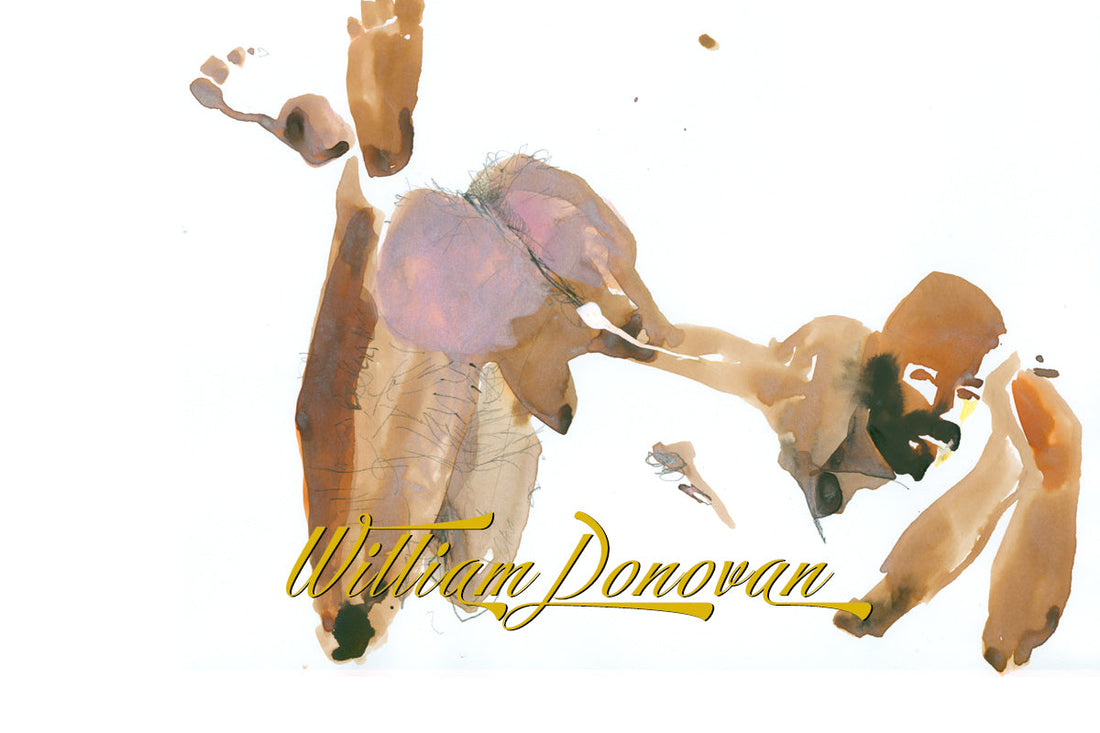
The work in this issue of Inspiró is immediately arresting. Look at the painting we reproduce here: a male figure materializes out of a field of amber and burnt orange, rendered in watercolor, ink, and pencil on archival paper. The body is simultaneously present and dissolving, built from washes that pool and bleed, from scrawled marks that crackle across the surface like nerves firing. Crimson bleeds into blush. Dark ink pools and then fades. The figure twists, arm raised, torso arched, as if caught mid-reach for something just beyond the canvas edge. There is nothing clinical about it. It vibrates.
This approach, embracing accident and chance rather than fighting them, is central to how Donovan thinks about this body of work. The homoerotic charge of the imagery is not incidental; it is the very point. He is exploring, as he puts it, "male sexuality, desire, passion and lust" through a combination of mixed media, with the intention to be both explicit in feeling and wholly reverential in approach. The content is charged. The treatment is careful. That tension, rawness held in a frame of deep respect, is what makes the work so affecting.

Seldom Seen, Deeply Felt
For most of his career, William Donovan's fine art has circulated quietly, in group shows, at galleries in Chelsea, in the rooms of collectors who sought him out. In 2024, the SoHo Project Space gave this work its most prominent platform yet: an exhibition titled Haute by Day, Hot by Night, which the gallery described as a rare public opportunity to encounter the artist's most inspired and most personal work. For those who know Donovan only through Dior beauty counters and editorial pages, the show, and the work in this magazine, is a revelation.
The dual naming convention also reflects something quietly meaningful about queer creative identity: the idea that an artist might need more than one name not out of shame, but out of an insistence that each mode of being be given its full, undivided space. Bil is fashion's man. William belongs to desire and loss and the burning facts of a life lived as a gay man in New York across five decades.

A Practice Built on Feeling
In his teaching, at FIT, at Parsons, at the Art Students League, Donovan has long championed the idea that art requires more than skill. It requires the willingness to be moved, and to let that movement show. His fashion illustration operates on a principle of selectivity: less is more, the gesture over the statement. His personal painting inverts this, it is accumulative, layered, risky, willing to be messy in the service of truth.
He has also been a consistent force for queer community and visibility, volunteering with Live Out Loud, an organization promoting education and empowerment for LGBTQ+ youth. The advocacy work and the paintings exist in the same continuum, both are acts of making gay life visible and dignified.
You can follow William Donovan on Bluesky, where he continues to share both the fashion and the personal work, without apology, in the same feed.
In Issue 5 of Inspiró, we are proud to offer these paintings the space and attention they deserve. They are the work of a man who has spent a lifetime honing his craft in public, and a lifetime exploring his deepest self in private. Now, in these luminous, unsettling, beautiful paintings, both lives meet.


