
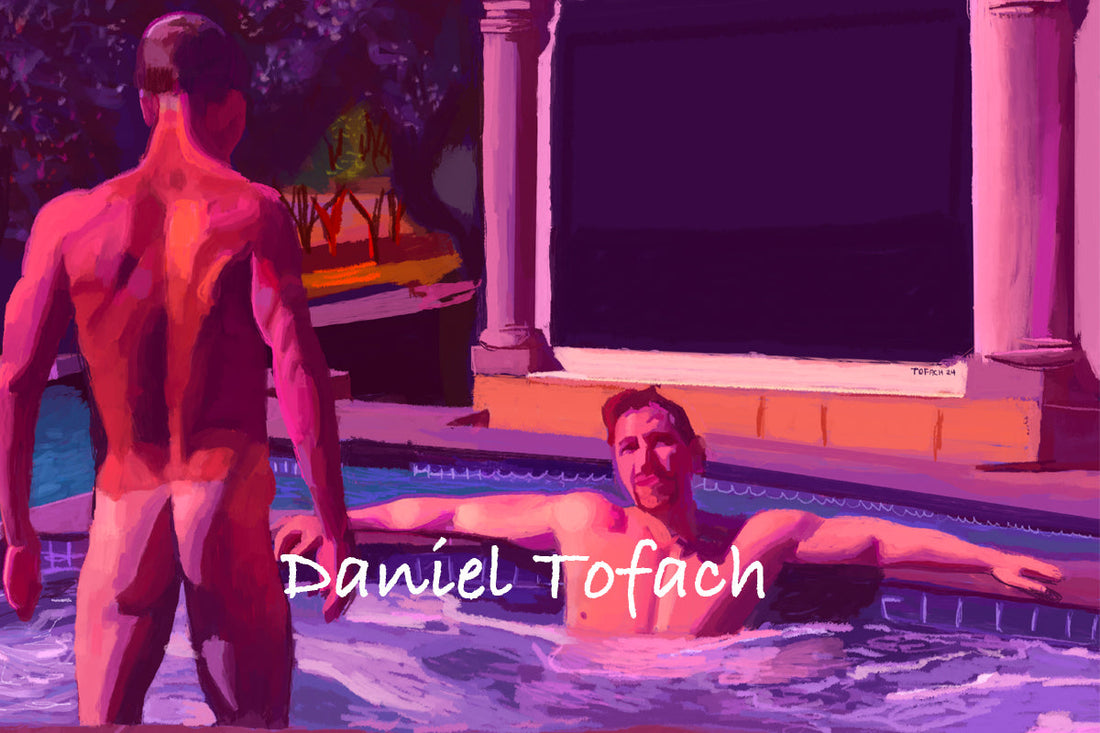
There is a moment that happens when you first encounter a painting by Daniel Tofach. You lean in, expecting to find evidence of a hand, a bristle mark, a smear of pigment, and instead you find something stranger and more beautiful: the ghost of one. His work sits in that electric space between what you think you're seeing and what is actually there, between the classical and the contemporary, between the deeply private and the defiantly visible.
Tofach is a multidisciplinary Canadian artist, theatre-maker, and proud member of the 2SLGBTQIA+ community, and his digital paintings are among the most quietly radical works being made in queer art today. Featured in Issue 6 of Inspiro Magazine, he is an artist whose practice demands, and rewards, your full attention.

A Classical Education, Turned Inside Out
To understand what Tofach does, you first need to understand where he comes from. Classically trained, he arrived at digital art not as an escape from tradition but as a continuation of it. His work applies the painterly logic of the Impressionists, the attention to light, the emotional weight of color, the sense that a scene is caught mid-breath, to the tools of the 21st century.
The Impressionist painters of the late 19th and early 20th century are a clear touchstone. That lineage is visible in his use of exaggerated, saturated light, in the way skin seems to glow from within, in the sense that each portrait has been lived in rather than staged. But where those painters were often working from a tradition of idealization, Tofach is working from something more honest: the specific, textured reality of queer experience.
His technique employs a trompe-l'oeil approach to texture and brushstroke, digital surfaces that fool the eye into reading them as painted canvas. The result is work that appears simultaneously hyperrealistic and impressionistic, a paradox that feels entirely intentional. These are not images that want to be pinned down.

Portraits That Hold Their Subjects With Care
Scroll through his portfolio at tofachart.com and you encounter a gallery of men: Eduardo, Helder, Marcelo, Naeem, Carmine, Richie, Mika. Names that feel like an intimate record rather than an exhibition catalogue. The titles are deliberately plain, "Marcelo Standing in the Doorway," "Helder in the Green Room," "Carmine in the Sun", locating these men in unheroic, domestic, human moments.
This is very much by design. Tofach's portraiture is concerned with the lived experiences of marginalized people, with those quiet or private moments of queer joy that so rarely make it into the canon of Western art. The male nude has a long and complicated history, idealized, eroticized, made mythological, and Tofach steps into that tradition with clear eyes. His subjects are not gods or symbols. They are men, specific and known, caught in the light of an afternoon.
Alongside the portraiture are works with more metaphorical titles, "He Loves Me Not," "The Goodbye," "Sinking," "The Breeze", that gesture outward from the individual into something more universal. These are paintings about feeling, about the emotional weather of a life. Together, the body of work functions as a sustained meditation on resilience and the politics of being seen.

Theatre, Site-Specificity, and the Immersed Audience
Tofach's practice extends well beyond the canvas. He is also a theatre-maker whose work engages with site-specificity and audience immersion, forms of practice that share, perhaps more than they first appear to, the same central preoccupation as his visual art: what does it mean to be looked at, and what does it mean to look?
Site-specific theatre asks its audience to inhabit a space differently, to become aware of their own presence within it. Immersive work collapses the distance between observer and observed. These are deeply queer concerns, the politics of visibility, of who gets to occupy space, of how a body is read in a room, and they run like a current beneath everything Tofach makes.
His dual practice is not a contradiction. It is a single sustained inquiry, pursued across multiple forms.

Why This Work Matters Now
We are living through a moment of genuine urgency for queer art and queer visibility. The representation of 2SLGBTQIA+ lives in mainstream culture has expanded significantly in recent decades, but representation and visibility are not the same thing. Images can be present without being honest, inclusive without being intimate.
What Tofach offers is something rarer: intimacy. His subjects are not emblematic. They are not there to represent a community or make a political argument, though the political argument is implicit in every image. They are there because they are particular, because their faces and bodies and the light that falls across them are worth the extended attention of a painter. That insistence on particularity, on the individual queer life as worthy of the same sustained artistic gaze once reserved for gods and aristocrats, is quietly revolutionary.
In an era of rapid content consumption, Tofach's paintings require you to slow down. They are built from layers of decision-making, color, light, composition, the precise angle of a shoulder, that reward the viewer who lingers.
Inspiro Issue 6: A Space for This Work
Inspiro Magazine has always been committed to platforming artists who are doing something genuinely new with inherited forms, artists whose work is in conversation with tradition without being captured by it. Daniel Tofach is exactly that kind of artist.
Issue 6 brings his work to a wider audience, and if you haven't yet spent time with his paintings, this is your invitation. Begin with the portraits, with Eduardo in the shower light, with Marcelo in the doorway, with the extraordinary "He Loves Me Not", and let yourself stay a while.
You can explore more of Tofach's work at tofachart.com and follow his ongoing practice on Instagram at @danieltofach_art.


