
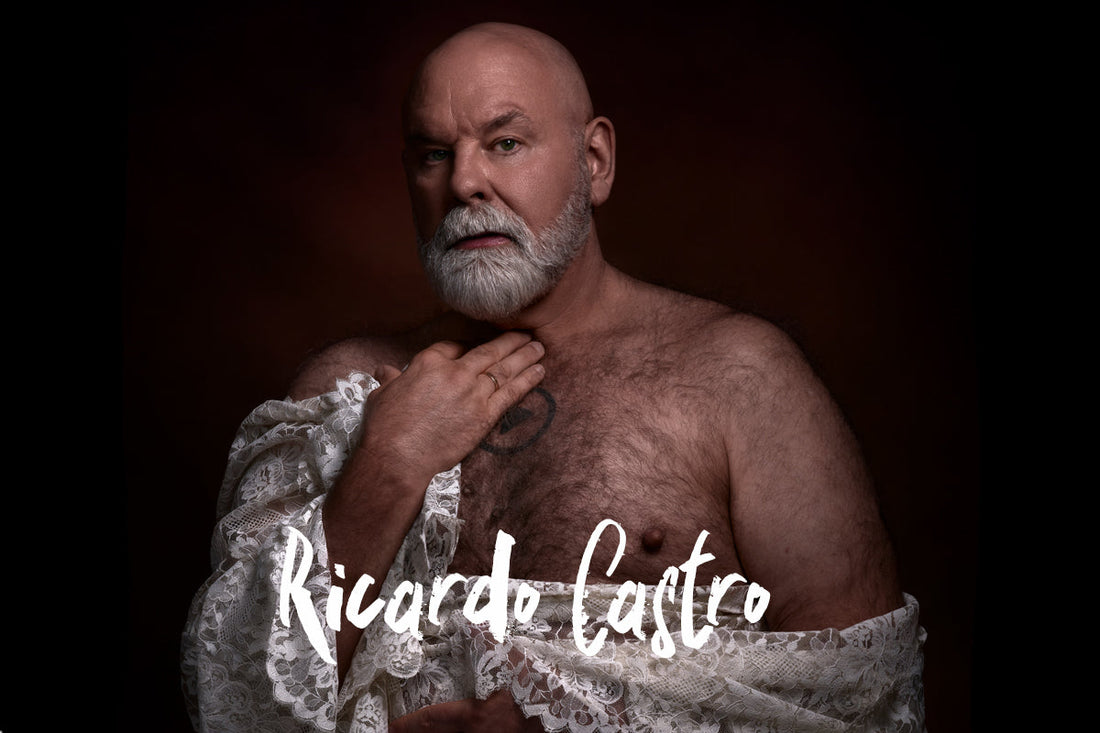
When a boy was forbidden to dance, he hid in his mother's wardrobe — and found a universe. That secret became a body of work that is rewriting what Spanish art is allowed to look like.
There is a photograph, or rather, a feeling that photography rarely achieves, of light breaking through darkness in a way that feels less like technique and more like revelation. This is the language of Ricardo Castro, and it is a language that has been centuries in the making.
Castro is a photographer, choreographer, and dancer. He is also a recipient of Spain's National Cultural Treasure designation in flamenco, one of the country's highest artistic honours. But titles only begin to describe a man whose work lives at the intersection of personal reckoning and radical beauty. We are proud to feature him in Inspiró Magazine Issue 6, and if there is one artist whose work demands to be sat with, returned to, and felt, it is him.

The Body as Archive
Ricardo Castro does not simply take photographs. He builds testimonies.
Trained across some of the world's most prestigious stages, from the Teatro Bolshói and the Mariinski in Russia, to productions alongside the American Ballet Theatre, the Opéra de Paris, and the Royal Ballet, his years as a principal dancer and choreographer forged in him an understanding of the body that goes far beyond the physical. The body, for Castro, is a site of memory, resistance, and transformation.
As co-founder of Castro Romero Flamenco alongside his sister Rosario, his photographic eye is inherently choreographic. Every frame is composed with the same precision as a stage: the placement of light, the weight of a gesture, the emotional charge of stillness. His fine art photography, printed on Hahnemühle Museum Etching 350gsm using archival Giclée techniques, is presented in strictly limited editions, each one signed, numbered, and accompanied by a certificate of authenticity. These are not images. They are objects that carry a life inside them.

A Golden Age, Queered
What makes Castro's visual language so singular is the tradition he draws from, and what he dares to do with it.
His work is rooted in the aesthetics of baroque chiaroscuro: the dramatic interplay of light and shadow that defined the masterworks of the Spanish Golden Age. Think Caravaggio, Ribera, Zurbarán, painters who used darkness not as absence but as presence, whose light fell on saints and martyrs and nobles with the force of divine intention. That visual grammar, once reserved for the sacred and the powerful, has been closed to certain bodies for centuries.
Castro opens it wide.
In his lens, the baroque canon becomes the stage for desire between men, for non-normative tenderness, for femininity inhabiting bodies that were never invited into these gilded frames. His work does not imitate the Golden Age, it reclaims it, refuses its exclusions, and insists that queer bodies are worthy of exactly the same reverence that the old masters reserved for their subjects. The effect is not subversive for its own sake. It is luminous, spiritual, and deeply moving.

"In the Darkness of a Wardrobe Full of Flamenco Dresses, I Found My Light"
At the heart of Castro's practice lies a story that is both deeply personal and unmistakably universal.
He was born into a family of artists. His mother was a celebrated bailaora. Dance surrounded him, and yet, for the young Ricardo, it was forbidden. His father's prohibition did not silence the call. It drove it underground.
In secret, he would watch his mother's classes through the windows. He memorised every movement. Then he would run to the wardrobe, full of his mother's flamenco dresses, and there, hidden in silk and lace and shadow, he would teach himself to dance.
That wardrobe became his first stage. Those stolen hours became his education. And those forbidden gestures became, eventually, his destiny.
His series "Forbidden" — selected for MADO 2025 — transforms this memory into art of extraordinary power. Male bodies emerge from darkness dressed in the traditional costumes of female Spanish dance. The photographs do not explain or justify. They simply insist: this is true, this is beautiful, and it was always this way. Through the lens of baroque chiaroscuro, the wardrobe of his childhood becomes a cathedral. The prohibition becomes the very source of his freedom.
"De bailarín oculto a Premio Nacional de Danza: mi prohibición se convirtió en mi destino." (From hidden dancer to National Dance Prize: my prohibition became my destiny.)

Art for Sensitive Souls
What unites every body of work Castro has produced, across photography, choreography, and performance, is a commitment to those who have been told they are too much.
"I make art for sensitive souls," he writes, "so they can discover that their difference is a gift, not a burden."
This is not a platitude. It is a programme. Castro's art is addressed to everyone who has felt forbidden, whose desire, whose tenderness, whose way of moving through the world did not fit the shape that was prepared for them. His photographs do not offer consolation. They offer something more: the radical proposal that sensitivity is strength, that difference is not a wound to be healed but a power to be claimed.
His exhibitions have reached some of Spain's most significant cultural venues — from the Museo de Historia de Madrid to IFEMA, from the Casa de Vacas in the Retiro to Studio RGF Arriaza 11 — and his gaze continues to expand. At every stop, the response is the same: recognition. The feeling of being seen.

In Issue 6
Inspiró Magazine has always believed that beauty is not decorative, it is political, spiritual, and necessary. Ricardo Castro is, in every sense, the embodiment of that belief.
In Issue 6, we explore his world: the baroque roots and the queer disruption, the dancer who became a photographer, and the child in the wardrobe who lit his own way out.
This is work that does not ask for permission. It simply arrives, with the force of something that has been waiting too long to be seen.
Inspiró Magazine Issue 6 is available now.
Explore Ricardo Castro's work at ricardocastrophoto.com


