
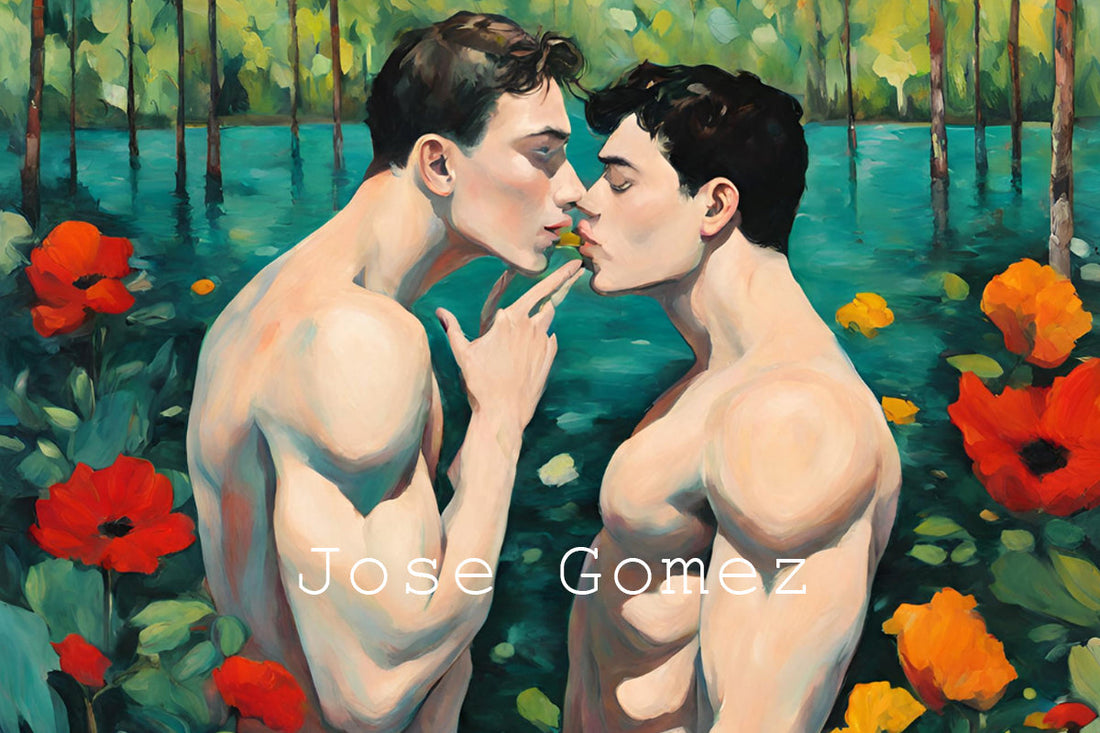
A Sevillano painter in London, José Gomez layers vivid colour, queer identity, and the electrifying geometry of two cultures into work that refuses to whisper.
There is a particular kind of light in Seville, warm, golden, and naturally theatrical, that seems to leave a permanent watermark on the soul of anyone born under it. For José Gomez, that light never left. It just found new surfaces to land on: the canvases he stretches in his London studio, the vivid acrylic palettes he reaches for without hesitation, the figures of gay men in motion that populate his most celebrated series. You can experience a sampling of these pieces in the pages of Inspiró Magazine 5.

Born in La Puebla de Cazalla, in the heart of Andalusia, and now firmly rooted in London, Gomez is that rare kind of artist who carries two worlds inside him without the discomfort of choosing between them. Seville gave him form, its Gothic and Arab architecture, its geometric Moorish tilework, its extravagant Baroque altarpieces. London gave him freedom, to be openly, proudly, visually gay, and to exhibit that identity in a city where queer art has long been given a stage.
"I consider my cultural identity a significant inspiration for my work, as well as my gay identity and everyday observations around London."
— José Gomez
Gomez trained formally at the Seville Art School before making the leap to London, where he studied Sculpture at the prestigious Camberwell College of Arts, graduating with a BA (Hons) in 2012. That sculptural foundation, the attention to volume, mass, and negative space, quietly underpins everything he paints, even when the work appears purely two-dimensional. You sense it in the way his figures occupy the canvas with physical presence, and in the way his abstract works build architecturally, layer by coloured layer.

The Human Figure, Unashamed
If there is one thread running through Gomez's figurative work, it is the unabashed, joyful celebration of gay masculinity. His ongoing series Men and Sport is perhaps the most immediately joyful expression of this: fictional gay sportsmen rendered in bold, poppy colour, athletic and sensual, representing an identity that mainstream sporting culture has historically ignored or erased. The series carries David Hockney's cheerful confidence in gay subjecthood, remixed through a Spanish sensibility and a distinctly London energy.
Gomez cites Hockney as a key influence, alongside Velázquez, Francis Bacon, Ocaña, Peter Doig, and Pablo Picasso, a constellation that reveals the range of his visual imagination. He is as comfortable with the raw psychological intensity of Bacon as he is with Hockney's sun-drenched ease. What he pulls from Velázquez, the great Sevillano master, is perhaps the most personal thread: a commitment to the human presence, to paint that feels inhabited.

Geometry, Colour, and a Bicycle Tube
For those drawn to Gomez's abstract work, the EGC series offers a masterclass in conceptual playfulness. What appears at first as pure geometric exuberance, tessellating shapes, electric colour contrasts, compositions that hum with optical energy, carries a quieter ecological statement. Gomez borders his compositions with recycled inner tubes from bicycles, a material choice that is simultaneously elegant and pointed: a subtle commentary on consumerism, on what we discard and what we might reclaim as beautiful.
He described the series himself as "an eclectic explosion of geometrical compositions blended into a mix-mash of vivid colors that seeks to trick the eye of the spectator as much as it wants to stimulate it." The work debuted in Madrid with Galería Azur and later travelled to Barcelona for Art Number 23's international showcase, Gomez's first time exhibiting in Catalonia, and by all accounts a homecoming of sorts for an artist whose work carries deep Mediterranean DNA.
"I hope these paintings will resonate with them, with a sense of calm, electricity, and effervescence."
— José Gomez, on his EGC series

A Voice in the Queer Art Conversation
Gomez has built a sustained, committed presence within London's LGBTQ+ art scene, and his exhibition history is a record of that community's resilience and creativity. He has shown in four significant exhibitions celebrating LGBTQ+ life: Loudest Whispers at Saint Pancras Hospital (a long-running fixture of queer London), Reflections of Apollo at the KZNSA Gallery in Durban, South Africa, The LGBTQ LIFE Exhibition at the Brixton (Tate) Library, and Together Stronger at St. Margaret's House in London.
That international reach, Durban, Madrid, Barcelona, Valencia, London, speaks to an artist who is not content to remain in one conversation. Gomez occupies an interesting position: a queer Sevillano whose work is unmistakably rooted in the richness of Spanish art history, yet radically translated through the lens of London's queer culture. He is, in a sense, a bridge, between abstraction and figuration, between Spain and Britain, between the private and the joyfully public.

Seville Returns
In February 2025, José Gomez brought his work home. His solo exhibition Paisajes en Tecnicolor (Landscapes in Technicolour) opened at the Las Sirenas Civic Centre in Seville, a deeply personal return to the city that shaped his visual imagination. There is something quietly poetic about a gay Spanish artist, trained in London, bringing his queer and vibrant vision back to a city whose beauty is inseparable from its Catholic and Moorish heritage. Gomez does not resolve that tension, he paints through it, and the results are electrifying.
His newest work, the Chromatic Flow series of 2026, continues this pursuit of pure painterly sensation: acrylic on canvas, intimate in scale, vast in colour ambition. It is the work of an artist who has found his voice and knows, with complete confidence, how loudly to use it.
View more of José Gomez's work in Inspiró issue 5.
José Gomez's work is available to view at josegomezart.com and on Saatchi Art. Follow him on Instagram at @joseglondon.


