
Architecture, Desire, and the Intimate Spaces We Inhabit: Lukasz Leja's Vision for Queer Love
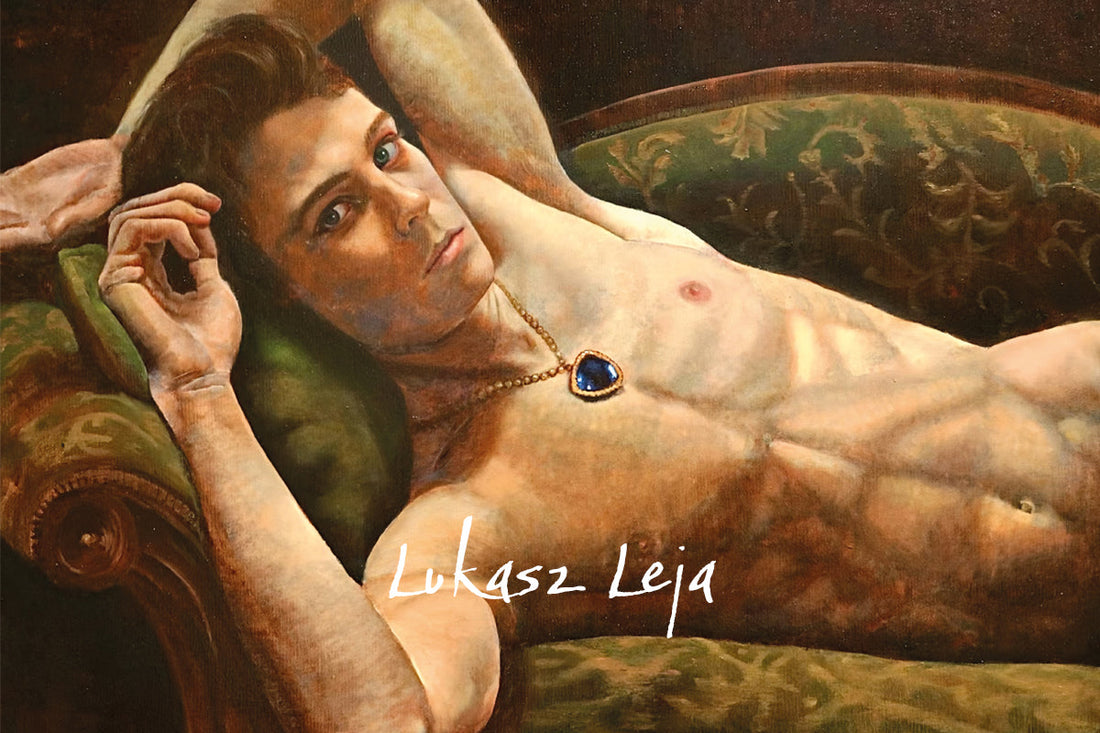
When Lukasz Leja paints, he is documenting a conversation between two separate lives: the one he built as an architect designing hospitals across Africa and civic spaces for the world's most discerning clients, and the one he claims entirely for himself in the quiet interiors of his New York apartments. The Polish painter does not separate these identities so much as weave them together, using his understanding of space, proportion, and human scale to create paintings that feel simultaneously architectural and deeply vulnerable. The choice to feature Lukasz Leja on both the cover and inside Inspiró magazine's eighth issue, marking the publication's second anniversary, reflects something the magazine seems to understand intuitively: that the most urgent contemporary art often emerges from artists willing to expose the contradiction between their professional lives and their emotional truths.

Lukasz Leja was trained as an architect before becoming a painter, and this background informs everything he creates. He studied architectural design across three continents, England, China, and the United States, before completing his coursework at Harvard. After graduation, he designed cultural and civic projects for prominent New York firms, accumulating a roster of clients that reads like a contemporary power list: Richard Serra, the crown prince of Saudi Arabia, Lady Gaga. He has designed residential developments across Connecticut, New York, and the Hamptons. His first solo architectural design, a community research hospital in Benin, West Africa, is now complete. These accomplishments matter, but they are not why Lukasz Leja is becoming known. He is becoming known because of his paintings, where he approaches the human body as architects approach buildings, deconstructing intimacy into its compositional elements.

Turning His Attention To the Male Body
When Lukasz Leja began painting seriously, he turned his attention toward subjects he could not address through architecture: queer love, sexuality, kink, and the tender, complicated moments that exist between partners. His oil paintings are geometric and sensual at once. Two male figures might occupy a room with the same care an architect gives to doorways and load-bearing walls. A hand touches a shoulder, and the artist renders it with the precision of someone trained to think about human proportion and spatial relationships. The paintings are set almost always within interiors, in the apartments where Lukasz Leja has lived across his years in New York City. These spaces are not merely backdrops; they are participants in the work. The walls, the light, the furniture become evidence of a life that has been lived, a world accumulated.
The practice of Lukasz Leja incorporates a unique methodology that extends beyond the canvas. He stages photographs with the finished paintings, positioning himself alongside his completed work, creating a visual record of his own transformation over time. This is not vanity or self-promotion. Instead, it reflects a deeper investigation into how we document intimacy, how we preserve the ephemeral moments of love and desire. By appearing in these photographs, Lukasz Leja insists that the artist's body and the artist's life are inseparable from the work. He honors his subjects, many of whom are drawn from his personal relationships and his chosen family, by showing them with tenderness and without irony, even when depicting desire and kink. This approach distinguishes his work from much contemporary figurative painting, which often keeps a protective distance from its subjects.

Accolades and Exhibitions
In 2022, Lukasz Leja was awarded top honors at the Los Angeles Tom of Finland Emerging Artist Competition, a recognition that placed him in direct lineage with a tradition of queer art-making that refuses shame and celebrates desire. The Tom of Finland Foundation recognizes artists who explore sexuality and intimacy in their work, who push against the boundaries of what is acceptable to depict and discuss. The award to Lukasz Leja acknowledged what his paintings make evident: that he had something essential to say about queer community, about the specific ways that queer people love and desire and build intimacy together, and that he had developed a formal language sophisticated enough to say it.
Since then, Lukasz Leja has exhibited in New York City, Los Angeles, and Paris, building a body of work that continues to expand. His paintings have become increasingly assured, moving beyond the figurative studies of his early work toward compositions that feel more complex, more emotionally layered. The figures he paints are not generic types; they are recognizable as individuals, as people with specific histories and relationships. This matters. In an era of abstraction and digital art, when figuration itself has become somewhat countercultural, Lukasz Leja insists on the power of painting to capture something true about human connection.
Lukasz Leja and the Cover Art For Inspiró's 2nd Anniversary Issue
The decision to feature this particular piece by Lukasz Leja for Inspiró magazine's second anniversary issue, reflects a curatorial commitment to artistic fearlessness. A gloryhole rendered in oil on canvas, a bathroom stall transformed into an arena of desire and connection. This is not a safe choice for a magazine cover. It is deliberately subversive, a rejection of 'respectability politics' that has long constrained how queer sexuality and queer pleasure are represented in mainstream. By centering this particular work, Inspiró is asserting something crucial: that queer cruising culture deserves artistic attention, that the moments and spaces where queer people meet and experience pleasure are worthy of formal artistic investigation. The gloryhole, that humble architectural feature of anonymous queer intimacy, becomes in Lukasz Leja's hands both intimate portrait and political statement.
To place it on a magazine cover is to refuse the sanitized version of queerness, to insist instead on the messy, specific, embodied realities of queer life. Inspiró has never repeated itself, never played it safe with its cover selections, and this choice confirms the magazine's dedication to artists and images that challenge, provoke, and honor the full spectrum of queer experience.

Discover More About Lukasz Leja Onlinw
Lukasz Leja's contribution to contemporary queer art cannot be overstated. He has taken the formal sophistication of his architectural training and applied it to subjects that demand emotional honesty: love, desire, the specific beauty of queer intimacy. He has refused the safety of abstraction and the cool distance of much contemporary painting, choosing instead to make work that feels personal and urgent and true. The fact that Lukasz Leja appears on the cover of Inspiró magazine's second anniversary edition, as both featured artist and cover image, suggests that his moment has arrived. The art world is beginning to see what he has known all along: that painting queer love with honesty and formal sophistication is not a niche practice but the work of serious contemporary art. For those wanting to encounter his work directly, Lukasz Leja maintains an active presence online at lukaszleja.com, where his portfolio and artist statement offer deeper insight into his practice and vision. He is also accessible on Instagram at @lukaszleja, where he shares studio documentation, finished paintings, and the staged photographs that have become integral to his methodology. Inspiró issue eight is available through The Male Muse, offering readers not only the full feature on Lukasz Leja but access to his cover image and the manifesto of his artistic vision at this pivotal moment in his career.


