
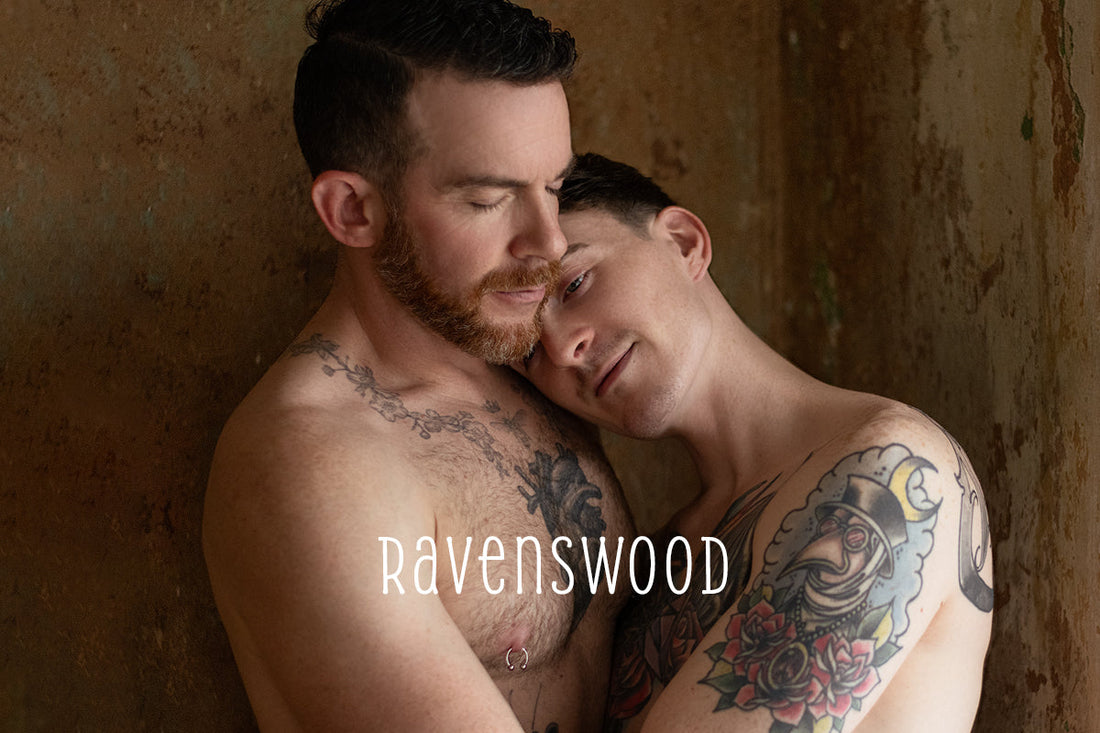
Ravenswood Evocative Male Nude Photography Shines in Inspiró Magazine's Inaugural Issue
Ravenswood, the Los Angeles-based queer photographer whose real name is Charlie Vaughn, has secured his place among the most compelling voices in contemporary queer photography with his striking male nudes featured in the debut of Inspiró magazine. In a landscape often dominated by fleeting digital content, Ravenswood's contribution to this inaugural issue represents something increasingly rare, a deliberate meditation on form, desire, and the interplay of light and shadow that evokes the romance of cinema's greatest era.
The launch of Inspiró magazine marks a watershed moment for international queer photographers. Created by The Male Muse Publishing and curated with meticulous care, Inspiró's mission is unequivocal, to amplify the voices and celebrate the contributions of queer photographers and visual artists who have been historically marginalized within mainstream art discourse. The magazine arrives as both a rebellion against the throwaway culture of digital imagery and a love letter to the possibilities of fine art photography. By featuring Ravenswood alongside eleven other international artists in this 100-page collectible, Inspiró magazine validates what serious collectors and curators have long understood, that Ravenswood's work deserves recognition on the global stage.

Cinematic Roots and Artistic Vision
Ravenswood's aesthetic doesn't emerge from a void. Like so many photographers who create from a place of authentic vision, his work is deeply rooted in what came before. The photographer takes his name from the Ravenswood building, a historic Hollywood structure that once housed the legendary Mae West. This choice is telling. Ravenswood isn't simply naming himself after a location, he's aligning himself with an entire era, a time when Hollywood understood that lighting, shadow, and composition could transform an image into something transcendent.
"The first time I was ever floored by a portrait was when I discovered the work of George Hurrell," Ravenswood has reflected. Before the internet, when such discoveries required genuine effort, Ravenswood studied Hurrell's images obsessively, trying to reverse engineer the techniques that made them so luminous and psychologically penetrating. This wasn't idle admiration, it was the deep study of craft. Ravenswood's approach to photography is that of an apprentice to mastery, understanding that becoming an exceptional photographer means understanding how the photographers who came before solved the fundamental problem of how to render human presence in light.
Before committing fully to photography, Ravenswood worked as a director and producer of low-budget films. This background proves crucial to understanding his photographic vision. Working in film taught him how to think cinematically about image construction, how to compose for emotional impact, and how to work with actors to achieve authentic presence in front of the camera. When Ravenswood discovered that photography combined everything he loved about filmmaking, storytelling, working with performers, and the meticulous craft of image construction, the direction of his artistic life crystallized.

From Voyeurism to Vision
The genesis of Ravenswood's photographic practice reveals something essential about his work. The story, as he tells it, is intimate and vulnerable. He had just finished being intimate with a man, and as they lay in bed, Ravenswood was arrested by the light playing across the other man's body through a nearby window. Unable to resist, he asked if he could photograph him. The man agreed on one condition, his face must remain covered. That single gesture opened a door that has never closed.
What could have been merely a private moment became the seed of a photographic practice. Ravenswood understood, from that first shutter release, that photography offered him something he had been searching for without knowing it, a way to safely explore the visual world of desire, of bodies, of the erotic landscape that occupies such an essential part of human experience. Where many photographers shy away from the explicit territory of desire and sensuality, Ravenswood has made it the very center of his vision.
The sensual and moody quality of Ravenswood's images doesn't arrive by accident. His influences have expanded over the years to include George Platt Lynes, the legendary photographer who documented queer male beauty with unprecedented aesthetic sophistication, and Bob Mizer, whose groundbreaking work created a visual archive of male physicality during an era when such representation was profoundly dangerous. Ravenswood also draws inspiration from countless queer photographers on Instagram, understanding that this new generation of image makers is constructing a visual language of desire that belongs entirely to the queer community itself.

A Philosophy of Continuous Growth
What distinguishes Ravenswood from many photographers working within similar aesthetic territory is his philosophy of artistic practice. Early in his career, Ravenswood placed himself in a pressurized competition with other photographers, constantly measuring his work against theirs. This, he recognized, only led to diminishing returns, a rabbit hole of comparison that hollowed out his own creative voice.
Ravenswood made a conscious decision to shift his perspective. Rather than measuring himself against the next photographer, he committed to being better than his own last photo session. This seemingly small adjustment proved transformative, not only creating a healthier internal relationship with his work, but dramatically improving his technical and artistic skills. This philosophy speaks to the maturity and self-awareness that characterizes Ravenswood's approach. He understands that sustainable artistic development requires patience, consistency, and a willingness to compete only with oneself.

The Window as Portal
Those familiar with Ravenswood's extensive body of work will notice a recurring element, models positioned in front of windows, with light flowing across their bodies in compositions that carry an almost sacred quality. When asked about this tendency, Ravenswood offers a characteristically candid answer. "First and foremost, I am a voyeur," he explains. "Photography is my way of safely exploring that." This admission carries weight. Rather than pretending his work emerges from some abstract aesthetic principle, Ravenswood acknowledges the erotic truth at its core. Photography, for him, is a medium that allows him to engage with desire, with visibility, with the vulnerability of another human being, all within a framework of consent, artistry, and mutual respect.
The window motif that recurs throughout Ravenswood's oeuvre speaks to something deeper than mere compositional choice. Windows function in his work as permeable membranes between the private and the public, between voyeur and viewed. They reference the architecture of cinema, where audiences sit in darkness watching light-constructed images of human form and drama projected before them. Windows also invoke the tradition of observational painting and photography, the idea that the photographer (or painter, or viewer) is situated outside, looking in, witnessing something intimate without violating its essential privacy.
The irony is not lost on Ravenswood himself. He has noted, somewhat jokingly, that his first exhibition should perhaps be titled "Window Treatments," a pun that acknowledges both the aesthetic dominance of this compositional choice and the playful self-awareness with which he approaches his own work.

Inspiró Magazine and the Future of Queer Photography
The presence of Ravenswood in the debut issue of Inspiró magazine feels both inevitable and momentous. Inspiró's mission aligns perfectly with Ravenswood's aesthetic and political commitment. The magazine, printed on premium matte paper as a luxury collectible, refuses to apologize for its engagement with desire, eroticism, and the sensual dimensions of human form. In selecting Ravenswood alongside eleven other international artists, Inspiró magazine has recognized that queer photographers aren't supplementary voices in contemporary art discourse, they are essential, central, and utterly necessary to how we understand creativity, representation, and beauty in the twenty-first century.
Ravenswood's work within Inspiró resonates particularly strongly because it bridges past and present. His images carry the technical sophistication and compositional mastery of George Hurrell and George Platt Lynes, yet his subject matter, his willingness to center male desire and male sensuality without qualification, speaks to a contemporary moment in which queer artists have claimed permission to create freely. Ravenswood doesn't create from a place of justification or apology. His photographs assert that the male form, desire, vulnerability, and the erotic gaze constitute worthy subjects for fine art photography.
A Moment of Recognition for Ravenswood
For Ravenswood, the feature in Inspiró magazine's inaugural issue marks a significant moment of recognition and validation. Yet it also signals something larger about the cultural moment we inhabit. International publishers like those behind Inspiró magazine are now actively seeking out queer photographers, curating their work, and presenting it to audiences with the same seriousness and production value typically reserved for straight photographers working within conventional genres.
Ravenswood's inclusion in this debut demonstrates that Los Angeles continues to produce photographers of exceptional vision and technical mastery. From the golden age of studio portraiture captured by Hurrell to Ravenswood's contemporary explorations of male sensuality rendered in light and shadow, the city remains a place where photographers understand that an image can be simultaneously beautiful, erotic, vulnerable, and intellectually rigorous.
As collectors and enthusiasts of fine art photography discover Ravenswood's work through the pages of Inspiró magazine, they'll encounter images that reward sustained looking. These aren't photographs meant to be consumed quickly and forgotten. Ravenswood's male nudes demand contemplation, they insist that we sit with desire, that we recognize the complexity and humanity of the bodies before us, and that we understand the profound artistry required to render such intimate subjects with both honesty and aesthetic sophistication.
You can find more of Ravenswood on Instagram at @ravenswoodpictures


