
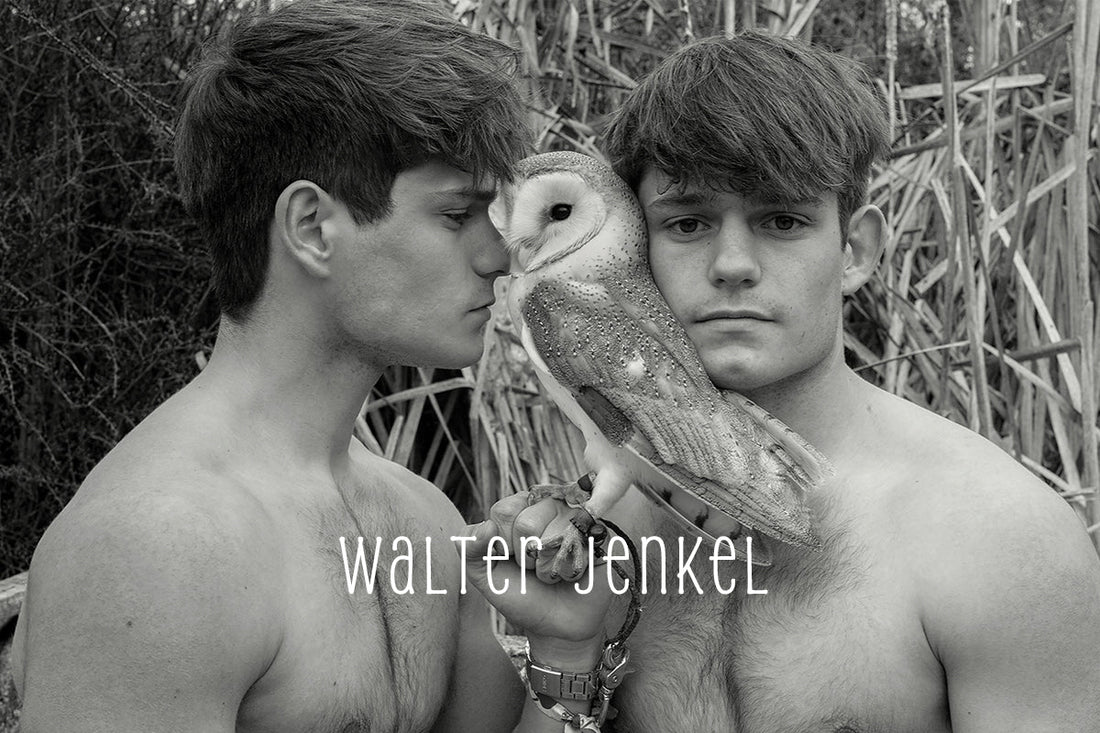
The Art of Walter Jenkel: Where Desire Meets the Wild
There is a particular kind of image that doesn't ask to be understood right away. It offers itself slowly, demanding a second look, then a third, because what it contains can't be absorbed all at once. Walter Jenkel makes photographs like that.
The Barcelona-based photographer is the cover artist for Inspiró Issue 5, and his presence in these pages is not incidental. His work, developed quietly over years, shot in studio spaces and sun-bleached ruins and open Catalan countryside, is some of the most distinctive male-focused photography being produced today. It is also some of the most difficult to categorize, which is precisely the point.

Stuttgart to Barcelona: A Photographer Finds His Own Language
Jenkel was born in Stuttgart, Germany, and came to photography largely on his own terms. Self-taught through private courses and the unforgiving discipline of professional practice, he spent his early career building model portfolios for agencies and working as a backstage photographer on international catwalks. That world gave him technical fluency and access, but it also gave him something to push against.
His entry into the mainstream came when GQ Spain published his first fashion editorials, followed by portrait and promotional work for record labels. During this period he photographed musicians and public figures of real stature, celebrity portraits that would have made a comfortable career for any number of photographers. For Jenkel, it was prologue.
In 2008, he made a decisive turn. He stepped back from the commercial machine and began what he has described as a more intimate practice, the world of auteur photography, on his own terms, exploring subjects that the world of fashion and celebrity had no interest in. The shift wasn't gradual. It was a pivot, and everything that has followed has come from it.

The Praise of Laziness: Learning to Look at Boys
His first significant auteur body of work, The Praise of Laziness, set the foundation for everything that came after. It was, at its core, a study of adolescence, of young male bodies occupying space without agenda, without the self-consciousness of modeling or the pressure of performance. The young men in these images were sprawled, unguarded, present. They existed in the frame the way teenagers exist in the world: halfway between nowhere and somewhere, energy going nowhere in particular.
The comparison critics have drawn to Caravaggio is apt. There is that same quality of light falling on young flesh without judgment, a softness in the palette that neither flatters nor diminishes, but simply records with an unusual reverence. These were not fashion photographs. They were closer to a study of a particular kind of male ease: the unhurried, unperformed presence of young men who aren't yet trying to be anything for anyone.
The Praise of Laziness announced that Jenkel was not interested in conventional beauty. He was interested in something stranger and more true.

A Poetics of the Ineffable: The Work That Defines Him
If The Praise of Laziness was the declaration, A Poetics of the Ineffable is the life's work.
This is the ongoing project that brought Jenkel to international attention and ultimately to the cover of Inspiró. Its premise sounds simple in description and reveals itself as endlessly complex in practice: non-professional young male models, photographed in close proximity to animals. Iberian species. Invasive species. Domestic creatures. Snakes and wolves, birds of prey and barnyard birds, wild boars and tame ones. The range is deliberate, Jenkel is mapping a relationship, not staging a spectacle.
The title comes from that quality in the images that language keeps failing to fully name. Something passes between the young man and the animal in each frame, a charge, a recognition, a mutual taking of measure, and Jenkel's camera catches exactly that moment. Not the dramatic moment. Not the posed moment. The suspended, alive, uncertain moment between connection and distance.
The ecological dimension of the project is not decorative. Jenkel has spoken directly about his environmental concern, pointing to the fact that since 1700, more than 842 species have been driven to extinction by human activity, through deforestation, pollution, invasive competition, and hunting. A Poetics of the Ineffable is, among other things, a sustained argument in images for what we stand to lose. The animals in his photographs are not props. They carry their own weight, their own wildness, their own claim on the frame.
And yet, and this is the tension that makes the work so extraordinary, the images are also genuinely, unmistakably sensual. The proximity of young male body to animal body does something unexpected: it strips both of performance. You cannot perform for a wolf. A bird of prey is indifferent to how handsome you are. What results is a kind of accidental authenticity that Jenkel has turned into a method. The models' defenses come down because they have to. The images catch them in that openness.

The Method: Trust, Time, and the Same Faces
One of the most revealing things Jenkel has said about his practice concerns his relationship with his models. Unlike many photographers who cycle through new faces, Jenkel returns to the same young men, season after season, project after project.
"I like working with the same guys over a long period of time and being confident with them," he has explained, "which allows me to get to know them better and take more intimate photos."
This is not a minor detail. It explains nearly everything about what distinguishes his images. The boys across A Poetics of the Ineffable — people like Gerard, Rubén, Leandro, Joaquín, and Iván, who recur across multiple shoots — are not strangers to him, and the camera knows it. Familiarity is visible in every frame. These are not young men trying to be photographed. They are young men comfortable enough to simply exist in front of the camera, which is a far rarer and more valuable quality.
The animals rotate; the models stay. It creates an interesting inversion of how fashion and editorial photography typically work, the human element is the constant, the natural world the variable, and it gives the project a cumulative, almost novelistic quality over time. You begin to know these faces. You begin to wonder, as a snake winds between their fingers, what they're thinking.
He also chooses his subjects from close to home, neighbors, children of friends, people from his immediate Barcelona world. There is no casting call, no agency submission. The intimacy that comes through in the finished work is inseparable from how that work begins.

Barcelona as Canvas: Wilderness at the City's Edge
Jenkel's relationship to Barcelona is complicated in the way that artists who love cities but crave the wild often find themselves complicated. He has spoken of being drawn to the feeling of wilderness, of seeking out the large abandoned houses at the edges of things where wild boars wander and nature reasserts itself through the crumbling architecture.
This tension, the city-dweller who shoots in transitional, half-wild spaces, is written into the images themselves. His locations tend toward the liminal: not deep wilderness, not urban landscape, but the edge places where one becomes the other. Sun-bleached stone walls, overgrown fields, the particular quality of Mediterranean afternoon light falling on skin and feather and scale. It is a visual world that could only have come from this specific corner of Europe, even as the themes it explores are fully universal.
Barcelona appears in the work not as a backdrop but as an atmosphere, the light, the heat, the particular textures of a city where the ancient and the modern share walls, and the countryside is never far.
On Snakes, Wolves, and Misunderstanding
One of the more striking aspects of Jenkel's work is the species he chooses to include, and his attitude toward them. He has been asked about accidents and dangerous encounters, particularly with snakes, and his answer reveals the philosophy underneath the whole project.
He sees the fear that contemporary urban life has cultivated toward certain animals as a misunderstanding, a consequence of civilization's long estrangement from the natural world. We have forgotten, he argues, that most of these animals' instincts run toward avoidance of humans rather than attack. The snake in a Jenkel photograph is not dangerous. It is disinterested. That disinterest, held alongside the young man's careful, curious proximity, is where the image lives.
It is an ecological as much as an aesthetic argument. The photographs don't just depict the relationship between humans and animals, they propose a different way of imagining it. Less domination. More attention. More humility about what we are to them.

What His Work Means in Inspiró
The images appearing in Inspiró Issue 5 are largely previously unpublished, making this edition a genuine collector's event for anyone who has followed Jenkel's practice. To encounter them in a premium print format, at the scale and quality the physical magazine provides, is to meet work that screen reproduction simply cannot deliver. The tactile reality of a well-made print magazine is part of what Jenkel's work requires: these images need to be held, not scrolled.
His photography is not easy, and it was never meant to be. It does not deliver instant reward. What it offers is something more lasting, images that earn their power through patience and honesty, that find the erotic in the ecological, that refuse to separate desire from care or beauty from consequence.
In a landscape of queer visual publishing where much work chases the immediate and the obvious, Jenkel's presence in Inspiró is a signal about what this magazine values: photography that takes its time, trusts its subject, and asks the viewer to do the same.
Some photographs exist to be scrolled past. Walter Jenkel's exist to be returned to.
Get Your Copy
Inspiró Issue 5 (Autumn 2025), featuring Walter Jenkel's previously unpublished work alongside eleven other international queer artists, is available now at The Male Muse Store, with a digital edition also available.
US customers will need to order through The Male Muse Blurb Store.


