
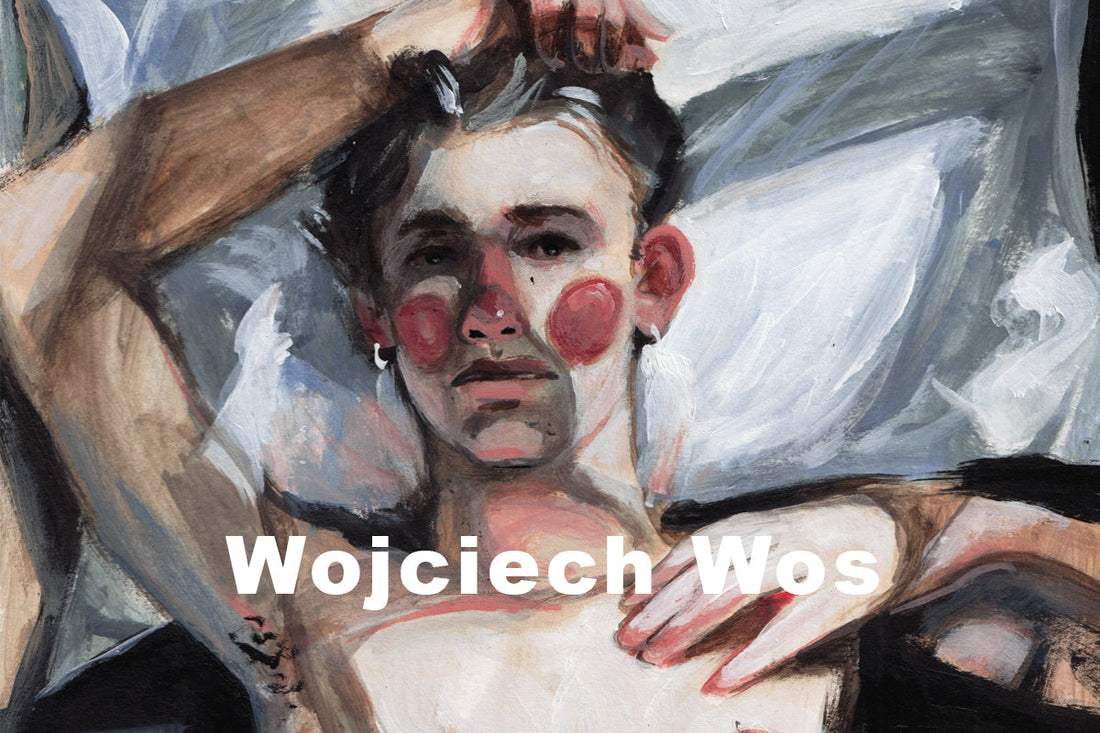
We proudly feature Wojciech Wos in Inspiró Magazine issue 5.
Born in 1993 in Słubice, a small Polish city on the German border, Wos has spent his adult life crossing thresholds, geographic, emotional, and artistic. At nineteen, he moved to Northern Ireland, where his journey as a painter took its first real steps. He studied, he experimented, he showed his work. In a striking early memory he recalls the absurdity of hanging nude queer self-portraits in a conservative Northern Irish bank during his first group exhibition, a collision between his unapologetically intimate art and the world still catching up to it.
It was in Berlin, however, where Wos truly found his voice, and his subject matter found him.

A City That Keeps Shaping Him
Wos relocated to Berlin in the midst of the pandemic, a period that might have paralyzed another creative spirit. Instead, he turned inward and outward simultaneously: painting from his bedroom, building connections with people who responded to his work, and slowly absorbing the particular energy of a city that has long served as a sanctuary for queer artists, thinkers, and dreamers. Berlin did not just give him a place to live. It gave him permission.
"I moved to Berlin during the whole pandemic," he has said. "I cannot experience the city the way I would like to, but I am trying to stay very positive. I definitely have more time to create and interact with people that appreciate my work."
That gratitude threads quietly through everything he makes. Berlin continues to shape his creative process, its liberating atmosphere, its queer community, its openness to vulnerability as both a political and aesthetic act.

The Sad Boys with Rosy Cheeks
If you scroll through Wos's Instagram or his portfolio, a recurring figure emerges: young men, tender and melancholic, often alone or caught in a moment of interiority. He calls them his "sad boys with rosy cheeks", images that balance tenderness and melancholy in a single glance. These are not figures of defeat. They are figures of feeling.
Wos describes his own process with disarming simplicity: "Boys make me sad sometimes so I paint about it."
That line is half-joke, half-manifesto. Because underneath the lightness lies something genuinely radical, the idea that male vulnerability, male softness, male sadness are not only worth depicting, but worth celebrating. In a world that still asks men to perform strength, Wos offers another option: the beauty of the low point, the dignity of the weary stare, the quiet intimacy of a figure caught in their own emotional weather.
His paintings treat his art as a kind of diary, a record of intimate experiences, of the things he cannot always find words for. "As I don't know how to talk about stuff I go through sometimes," he has reflected, the canvas becomes the conversation.

Technique as Emotion
Wos works primarily in acrylics, but his touch is anything but mechanical. Bold, deliberate brushstrokes build up texture and presence. His color palette shifts between the soft and the striking, sometimes drenched in the watery blue hues he associates with melancholy and the volatile surface of water, sometimes erupting into warmer, more defiant tones. Always, the colors are chosen to create what he describes as "an intriguing play of light and shadow."
The blue, in particular, carries real emotional weight for him. He has described it plainly as "a very emotional colour. Pretty sad." But there is also something dreamlike in it, a sense of memory and longing, of scenes half-remembered from bedrooms and bicycle rides and quiet mornings.
Wos learned to paint by watching his father, who painted for pleasure. As a small child, he would ask his dad to recreate illustrations from his favorite books. Eventually, his father ran out of patience. So Wos picked up the brush himself, and never put it down.
His approach to style is equally organic. "Style is always inside of you," he has said. "It's a selection of our favourite ingredients put all together. I just needed to discover those ingredients by practicing and experimenting."

The Themes That Drive Him
Wos's work moves through several interconnected territories: queer experience and sexuality, love and longing, mental health, and the everyday textures of human connection. These are not abstract concepts for him. They are lived realities, pulled from his own life and from his acute observation of others.
"Human interaction can be very stimulating," he says. "I like to observe and sometimes I feel like I have some sort of super instinct looking at people and their behaviours."
The result is a body of work that feels both specific and universal. His queer perspective gives his figures a particular kind of interiority, the experience of discovering one's own desires, of navigating a world not always built for you, of finding freedom in cities and communities that understand the stakes of that freedom. Yet the emotional core of his paintings, loneliness, longing, tenderness, the complicated weight of love, extends far beyond any single identity.
He describes his work as "pretty love-orientated," adding: "Anyone could relate to it as I touch on problems that are very human, everyday things presented in my own way to make it more interesting and eye-pleasing."
Love, for Wos, is warmth. "I'm a big fan of warmth," he has said, "and love feels like warmth to me. I like to share my warmth and I never want to lose it with age and experience."

Imperfection as Integrity
One of the most compelling aspects of Wos's practice is his relationship with the finished work. He paints until a piece says what it was meant to say, and then he stops, even when he sees the imperfections.
"They are never perfect. I see all the imperfections immediately after I finish the painting but I never want to change it. Any extra brushstroke could change the character of the painting."
This is an artist who understands that perfection is the enemy of truth. The imperfection is the painting. The rough edge, the unexpected shadow, the stroke that went slightly too far, these are the moments where feeling breaks through technique. He is guided not by polish but by presence.
He keeps close a line by Henri Matisse, which he cites as something like a creed: "You study, you learn, but you guard the original naivete. It has to be within you, as desire for drink is within the drunkard or love is within the lover."
In Wos's hands, that naivete is not inexperience. It is a radical commitment to staying open, to painting with the full force of what you feel, before the world teaches you to edit it away.

What We See When We Look
Wos's paintings ask us to sit with discomfort without demanding resolution. A boy with rosy cheeks does not need to be explained or consoled, he simply needs to be seen. In that act of looking, something shifts. We recognize the feeling, even if we cannot name it. We are reminded that vulnerability is not weakness, that sadness is not failure, that the intimate struggles we carry quietly are, in fact, the very things that make us human.
This is what figurative art, at its most alive, can do. And Wojciech Wos is doing it — from Berlin, with a brush and a lot of feeling, one sad beautiful boy at a time.
Wojciech Wos is featured in Inspiró Magazine Issue 5. Explore his full portfolio at wojciechwos.com and follow his work on Instagram @wojciechwosx.


