
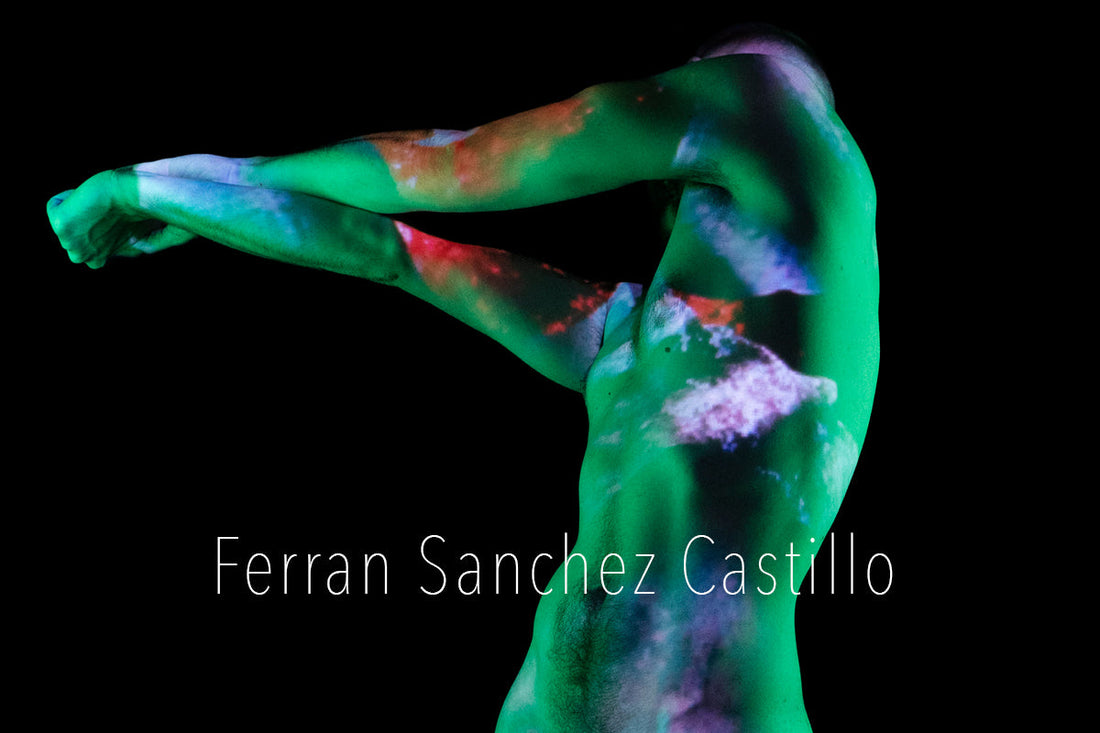
Light, Skin, and Defiance: Ferran Sanchez Castillo Is Rewriting the Language of the Male Body
Brussels-based, Catalan-born, and unapologetically queer, Ferran is one of twelve international artists featured in Inspiró Magazine Issue 5, the celebrated quarterly publication by The Male Muse that brings together the most compelling voices in queer art today. And in a magazine already overflowing with talent, Ferran's work stands apart: visceral yet tender, technically flawless, and morally urgent.

A Life Built Around the Image
Born in 1973 in Cornellà de Llobregat, a small city just outside Barcelona, Ferran picked up a camera at fourteen. While most teenagers were navigating school hallways, he was attending night classes at the Municipal School of Art, developing black-and-white prints in a darkroom, and, as he puts it, "living in his room" with his drawings and negatives.
It wasn't isolation. It was incubation.
He went on to study at the Institut d'Estudis Fotogràfics de Catalunya and then completed a superior degree in photography at Escola Serra i Abella. By the time he was eighteen, he had already shot his first male nude series. By the time he was twenty-one, he had his first group exhibition. Photography, he has always said, was never just a medium, it was his primary language.
His first solo exhibition was a series of nude self-portraits. For an adolescent still making peace with his own body, the decision to show himself fully, literally and metaphorically, was an act of radical self-reclamation. "For an adolescent not too happy with his body," he reflects, "it was a huge reconsideration, and possibly the beginning of my posterior creative process."

Barcelona, Geneva, Brussels: A Career in Three Acts
In the early 1990s, Ferran was immersed in Barcelona's underground scene, doing analogue VJing in clubs and exhibiting in legendary spaces like Espai Fotogràfic Maple Syrup. In 2000, he relocated to Geneva, where his practice expanded dramatically, into installation, music, theatre, DJ sets, performance, and what he describes as "all that I could use to make Art."
The turning point came in 2004. His solo exhibition "1 Mètre de Profondeur" (One Metre Deep) at Librairie Archigraphy in Geneva was greeted with critical praise and public enthusiasm. "At this moment," he recalls, "I thought my Art had the power to emote people and generate thoughts and questions." It was the first time he recognised himself unambiguously as an artist.
By 2009, Ferran had arrived in Brussels, a city that would become his creative home. A 2010 exhibition at Galerie 10/12 became the cultural "coup de coeur" of the season. Brussels kept calling. He stayed.
In 2024, his solo exhibition "Post Tenebras Lux" at Studio 84 placed him alongside work by Joel-Peter Witkin, Robert Mapplethorpe, Keith Haring, and Picasso in the group show "Les Liaisons Désireuses" at Kasteel d'Ursel, an exhibition exploring lust, seduction, and desire across sixty-two artists. The range of that company speaks volumes.

The Body as Canvas, the Nude as Argument
Ferran describes his artistic approach as hybrid, operating at the intersection of performance, visual art, and photography. He builds his own backgrounds, handles his own styling and makeup, manages lighting, and develops or retouches the final image. From concept to print, the work is entirely his. But the philosophy underneath is what makes it truly distinctive.
"I conceive the body as a blank canvas," he writes, "a support for techniques closer to the visual arts than to traditional photography, where light, matter, and human form merge into a single entity." His materials are real: the substances, colours, textures, and backgrounds that appear in his images are not digital fabrications. They exist. This commitment to physical authenticity gives his work a weight that purely post-produced imagery rarely achieves.
His subjects are almost always people from his own circle, friends, lovers, acquaintances. He works almost exclusively with non-professional male models. "The personal relationship between the model and me is as important as the photo result," he says. "They become part of my iconography and loved friends." The camera, in his hands, is not a machine that extracts images. It is an invitation to intimacy.

Queer Art as Political Act
Ferran is not naïve about the battles his work is fighting. He speaks clearly about the way heteronormative bias continues to police the representation of male bodies, in galleries, on social media platforms, and even in queer spaces. "Even in a gay friend's Art space," he notes with characteristic candour, "I was told 'your work is too gay.'"
This is the contradiction queer artists navigate daily: celebrated in certain contexts, marginalised in others, always asked to justify the legitimacy of their gaze.
Ferran responds not with anger, but with rigour. His work is published in Physique Pictorial (the legendary Bob Mizer Foundation magazine that has shaped homoerotic visual culture since 1951), in Pornceptual's platform for ethical and inclusive erotic art, and now in Inspiró, each platform a different facet of the same conviction that queer bodies deserve representation in art's most serious conversations.
His themes, transformation, rebirth, gender equality, the fragility of masculinity, are explored through bodies that are rendered luminous, naked of social markers, freed from the information that clothes impose: "social status, origins, age." What remains is the human. That is precisely the point.
The Inspiró Moment
Inspiró Magazine, published by The Male Muse, is one of the most significant curatorial platforms in contemporary queer art. Each 100-page issue brings together twelve international artists working across photography, collage, ceramics, illustration, painting, digital art, and beyond, united by a commitment to the exploration of the male form and queer desire in all its complexity.
Being featured in Issue 5 is not incidental recognition. It is a signal: that Ferran's thirty-plus years of practice, his geographic migrations, his technical mastery, and his unflinching moral clarity have made him one of the voices that defines what queer art looks like right now.
The magazine is printed on premium matte paper, a deliberate choice that insists on the physical, the tactile, the real. Ferran's work, which begins with real substances on real bodies in real rooms, belongs there entirely.

Why This Work Matters
"Faire une photo est toujours faire un autoportrait," reads the tagline on Ferran's portfolio site: to take a photograph is always to take a self-portrait. In this, every image he makes is simultaneously of his subject and of himself, a double exposure of desire, curiosity, and the relentless need to look clearly at the world.
His inspirations are eclectic and revealing: Mapplethorpe's use of the body as art object; Wilhelm von Gloeden's mythological compositions; Nadar's posed portraits; the Art Deco period; Space Age aesthetics; Neo-classical painting; the surrealism of Dalí and Magritte. And alongside these: New Wave and cold wave music, the cinema of Peter Greenaway, Kubrick, Jodorowsky, Cronenberg, and Tim Burton. His images are not made in a vacuum. They are made by someone who has absorbed the whole of culture and distilled it through a queer, embodied, uncompromising eye.
He wants, he has said, to challenge aesthetic norms. To deconstruct toxic masculinity. To propose a vision of the male body that embraces sensitivity and vulnerability. To achieve a representation of bodies that is, at last, "egalitarian and non-binary."
In 2025 and into 2026, that work continues: in exhibitions from Brussels to Mons to Rio de Janeiro, in publications from Physique Pictorial to Inspiró to Pornceptual, and in ongoing collaborations with dancers, performers, and artists across the European scene. A career that began in a darkroom in a suburb of Barcelona, a solitary teenager developing prints in the dark, has become one of the most compelling ongoing arguments in contemporary queer art.
Inspiró Magazine Issue 5 is available now at themalemuse.store
Follow Ferran Sanchez Castillo at @ferran.sanchez.photo (Instagram) and @ferran-sc-photo.bsky.social (Bluesky)
Portfolio: ferransanchezcastillo.myportfolio.com


