
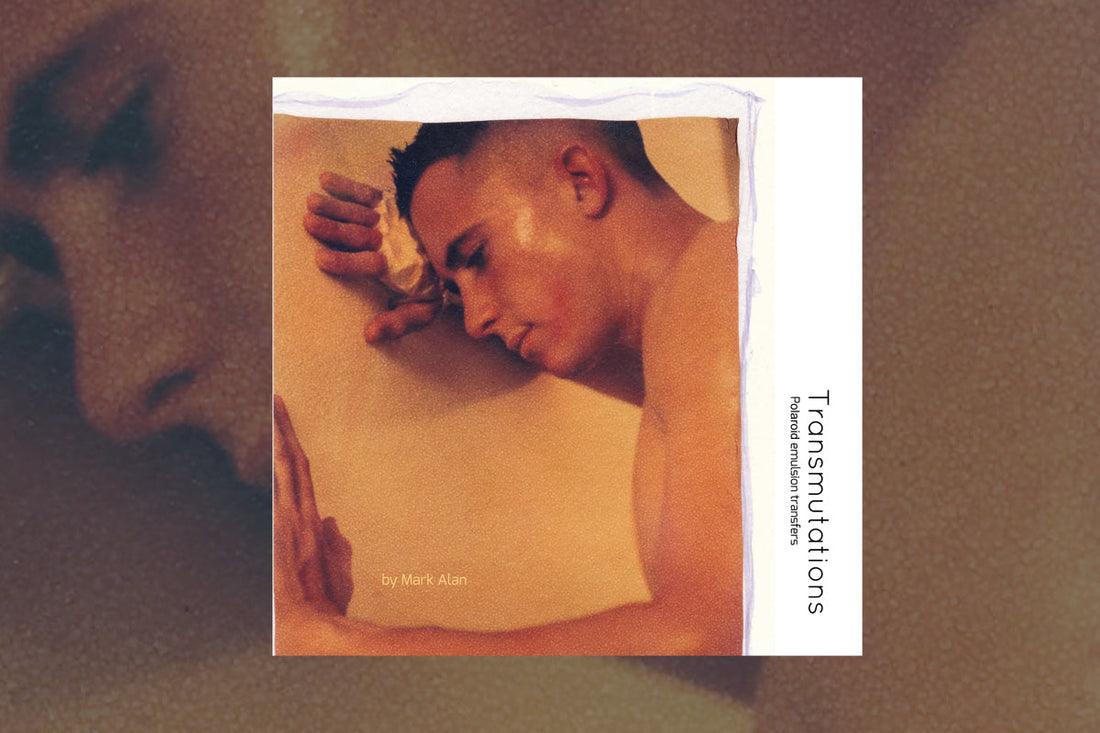
Transmutations: A Polaroid Emulsion Transfer Photography Book Where Chemistry Meets Fine Art
Before Instagram filters, before digital manipulation, and long before Photoshop became a verb, photographers were discovering extraordinary ways to transform images using chemistry, patience, and a willingness to embrace the unexpected. In darkrooms, studios, and even home kitchens, artists experimented with instant film to create photographs that blurred the boundaries between photography and painting. The results were unpredictable, deeply tactile, and impossible to reproduce exactly.
That fascinating process lies at the heart of Transmutations, a Polaroid emulsion transfer photography book by Mark Alan, the photographer behind the acclaimed fine art series The Male Muse. More than a collection of photographs, Transmutations is a celebration of analogue craftsmanship and artistic experimentation, capturing a moment in photographic history when every image became a unique work of art.

What Is a Polaroid Emulsion Transfer?
For those unfamiliar with the technique, a Polaroid emulsion transfer is one of analogue photography's most captivating and labour-intensive artistic processes. It begins with a Polaroid print, carefully trimmed before being submerged in hot water. As the print softens, the image-bearing emulsion separates from its plastic backing, floating free as an incredibly delicate, translucent membrane.
This fragile layer is then lifted and transferred by hand onto a new surface. For Mark Alan, that surface is fine art watercolour paper, chosen for its texture and ability to complement the organic nature of the transferred emulsion. The image can be gently positioned to retain its original appearance or deliberately manipulated by stretching, folding, wrinkling, or twisting the emulsion while it is still soft.
No two transfers ever behave in exactly the same way. Tiny air bubbles, unexpected tears, curled edges, and subtle distortions become part of the finished artwork rather than imperfections to be corrected. Every transfer becomes a one-of-a-kind original that can never be duplicated.
It is, in many ways, photography transformed into sculpture, with chemistry acting as both collaborator and creator.

Discovering an Extraordinary Process
Mark Alan's journey into Polaroid emulsion transfers began almost by accident after discovering an article in a photography magazine during the early 2000s. The technique immediately captured his imagination, but there was one obvious obstacle: he didn't own a Polaroid camera.
Fortunately, he discovered an ingenious solution. Existing 35mm slide transparencies could be projected directly onto Polaroid film using a specialised Polaroid slide printer. This meant he could revisit photographs he had already created without needing to reshoot them.
At the time, Mark's archive consisted of images from just six early male nude photography sessions. Rather than seeing that limitation as a disadvantage, he embraced it as an opportunity to experiment. By returning to the same photographs repeatedly, each transfer became an entirely new interpretation of the original image.
Some compositions remained faithful to the source material, preserving the delicate lighting and careful posing that defined the originals. Others evolved into something entirely different as the floating emulsion stretched across the paper, elongating figures, softening contours, and introducing painterly textures that no camera could ever capture.
The limitations of the medium became its greatest strength.

The Art of Surrender
One of the reasons this Polaroid emulsion transfer photography book feels so distinctive is that it showcases a photographic process that resists perfection.
In today's digital world, almost every flaw can be removed with a few clicks. Images can be endlessly refined, colours adjusted, and compositions altered until every detail appears immaculate. While digital technology offers incredible creative freedom, it also removes much of the uncertainty that once defined photographic practice.
Polaroid emulsion transfers work in exactly the opposite way.
The artist can guide the process but never completely control it. The emulsion responds to temperature, moisture, timing, gravity, and touch. Sometimes it tears unexpectedly. Sometimes it folds in beautiful ways. Sometimes colours soften or edges dissolve into the paper.
These moments of chance become part of the artwork itself.
Rather than fighting imperfections, the artist learns to collaborate with them, allowing each piece to develop its own character. Every transfer becomes a conversation between intention and accident.
That willingness to surrender control gives Transmutations its unique visual language.

Reimagining the Male Form
Throughout his career, Mark Alan has approached the male figure with sensitivity, respect, and an unmistakable artistic vision. His photography explores strength, vulnerability, beauty, and intimacy without sacrificing elegance or craftsmanship.
The Polaroid transfer process added another dimension to that exploration.
As the emulsion stretched and shifted across the paper, skin became almost painterly. Muscles dissolved into flowing textures. Highlights softened into washes of colour, while shadows gained unexpected depth. The familiar human form became dreamlike without losing its emotional presence.
These are not simply photographs of male nudes. They are interpretations of photographs—transformations that sit somewhere between photography, painting, printmaking, and mixed-media art.
It is this continual transformation that inspired the book's title.
The images have been transmuted not only physically through chemistry but creatively through experimentation, revealing possibilities that remained hidden within the original negatives.
A Rare Collection Preserved in Print
One of the remarkable aspects of Transmutations is that it documents an artistic process that can never truly be recreated.
The original Polaroid films used for emulsion transfers are no longer manufactured in the same way, and many of the materials and techniques that artists relied upon have disappeared entirely. Even if identical supplies still existed, every transfer would produce a different result because each piece depends on countless variables that cannot be repeated.
This makes the collection more than simply another photography publication.
It serves as an archive of a unique creative period in Mark Alan's artistic development, preserving work that exists nowhere else in exactly the same form.
Presented as a beautifully produced 50-page softcover volume in a 7 × 7-inch square format with a flexible laminated cover, the book reproduces the complete series of Mark's Polaroid emulsion transfer artworks created during this experimental chapter of his career.
For collectors of analogue photography, lovers of alternative photographic processes, and admirers of handcrafted fine art, it offers a rare opportunity to experience images that were literally impossible to duplicate.

Who Will Enjoy This Polaroid Emulsion Transfer Photography Book?
Whether you're already familiar with analogue photography or discovering the process for the first time, Transmutations offers something genuinely distinctive.
This book will particularly appeal to:
- Collectors of fine art photography books.
- Enthusiasts of Polaroid and instant film techniques.
- Artists interested in alternative photographic processes.
- Lovers of experimental and analogue photography.
- Admirers of the male figure in contemporary fine art.
- Anyone fascinated by the intersection of photography, chemistry, and handmade artistic practice.
Because every transfer exists as a singular artwork, the collection offers an experience unlike traditional photography books, revealing how chance and craftsmanship can work together to create extraordinary visual beauty.
Discover Transmutations
Transmutations is far more than a collection of photographs. It is a record of experimentation, patience, craftsmanship, and creative discovery. Every page celebrates an artistic process that embraces unpredictability and transforms ordinary instant film into extraordinary fine art.
If you're looking for a Polaroid emulsion transfer photography book that showcases both the beauty of analogue photography and the expressive possibilities of the handmade image, Transmutations is a unique addition to any photography library.
Available now through The Male Muse Store, this beautifully produced volume preserves a body of work that could never be recreated in exactly the same way—a lasting testament to one of photography's most fascinating alternative processes and to Mark Alan's enduring artistic vision.
Transmutations is available now from The Male Muse store. USA customers will need to order on Blurb.
For more of Mark Alan's work, visit linktr.ee/themalemuse.


